First published 29 June 2002 · the bracketed editor’s note and its links date from 2008 · revised and expanded 29 September 2026, with a note on the geometry and an addendum on the Hopf fibration. The 2002 text is kept as it was, apart from spelling.
The game
Following just the introductory teachings, there was but one thing that didn’t immediately rest with me structurally: the notion of changing by moment the lagna (ascendant), to adjust for various omens, so that, for example, if the native is touching his feet, we would use Pisces as the new lagna.
Intuitively this feels absolutely fine and certainly has amazing results, but I just wondered, in the gola and gaṇita (structure of the universe) view of things, how did it all fit in?
Well. Here’s my theory, just a theory, but it’s something to think about:
Do any of you know the “My mother told me…” fortune-telling paper game played by girls in elementary school?
Make the game! It’s tricky at first, but a lot of fun, and any American 11-year-old girl will be glad to help!
Well, moving this cubic chrysanthemum (this leaping lotus?) about, we would, with delight, tell fortunes: what’s your favorite flower, what boy will you marry, that sort of thing.
Nicely enough, unfolding the paper game gives you a familiar image of lines and crossings. It’s not only a straightforward kuṇḍalī but also a set of 4 smaller ones that would overlap if tiled together on a larger sheet.
The cool thing, geek-wise, is that this same representation is a hypercube, physicists’ standard four-dimensional representation of space-time, but that has been projected, or squashed down, to fit on a 2-D sheet of paper.
I propose that of course the ṛṣis knew all about this.
Editor’s note, 2008: Hey, if Chutes and Ladders can actually be a game on the līlā by seers from millennia ago, why not this one?
The donut
Moreover, take this paper and roll it into a tube. The tube will connect two of the four smaller charts contained within the larger chart. Now connect the ends of the tube to form a donut. This allows for the 4 “sub” kuṇḍalīs to finally all mesh together. What you have just done is form a torus.
Here is good further simple background on our donutty universe.
This torus shape is thought to be the shape of the real universe. If true, the ṛṣis would of course know of this too.
Also, please keep in mind that this torus, which is just a physical rotation of our same astrology sheet of paper (the hypercube of space-time, remember) allows for many additional known physical properties:
- black holes and space travel
- our ākāśic experience
- a structural explanation for the aṁśas (via fractalling)?
- and possibly other things too……?
The first two ideas above are by now pretty mainstream and accepted as legit at all social levels. The third is my just guessing around, but really, I wonder if maybe some more of the properties of jyotishical interpretation can be represented here.
The still point
For example, the one I couldn’t digest immediately: of changing the lagna to fit the moment.
Let’s go back to the folded-up gamesheet.
When you move your fingers about to offer your playmate a choice, the still-point (i.e. the topological Brouwer fixed-point, for those still following the math) for the choices offered remains the earth, the center of the kuṇḍalī, and the 1/4/7/10 bhāvas remain truly cornerstones.
Maybe your moving of the fingers is equivalent to a flexing of the facets of an individual, giving a type of choice.
Jai Shri Ram
So maybe that’s why, during a reading, we can look at the same individual equally validly while changing the lagna to fit the moment: because the game set stays the same, the facets of the crystal are just flexing, breathing.
Finally, considering that a chart maps the above universe onto our psyches, our motivations, our past lives, our physical illnesses, and more, there is certainly a complementary universe within (string theory allows for these hidden dimensions, ok?).
Hence our jyotishical diamonds truly contain the modeling of this whole universe.
Just like we always knew, by trusting our beloved teachers.
A note on the geometry, added in 2026
Twenty-four years on, I went back to the game with a ruler. Here is what the creases actually hold, and what I would now say about the three claims above: the four smaller charts, the hypercube, and the donut.
The chart in the creases
Fold the game, open it flat, and you have the pattern of figure 1a. The two diagonals come from the first folds; the diamond joining the midpoints of the sides comes from folding the four corners to the centre; the lines at quarter intervals come from the second round of corner folds, which crease straight through the flaps underneath; and the last fold in half, the one that opens the pockets, adds the two medians. The North Indian chart is in there exactly, not approximately: square, diagonals, diamond (figure 1b).
What I had not noticed in 2002 is the second chart (figure 1c). The diamond is itself a square, turned an eighth of a turn. Its diagonals are the sheet’s medians, and the small central square joins the midpoints of its sides, which is the definition of a chart’s diamond. So the game holds a chart inside a chart, the inner one rotated 45° and shrunk by 1/√2, and one can see that another round of folding would put a third inside that.
The precise version of my “four smaller ones that would overlap if tiled together” is figure 2. Tile the plane with charts and, at every corner where four of them meet, their eight corner houses fit together into one diamond, of four times the area of a kendra: houses 2 and 3 from one chart, 5 and 6 from the next, 8 and 9, 11 and 12. The kendras 1, 4, 7 and 10 stay private to their chart; the other eight are what neighbouring charts share. I like that better than what I wrote.
About the word hypercube
Honest accounting. The picture I had in mind in 2002 was the popular drawing of the tesseract: a square inside a square, with the corners joined. The chart resembles that drawing, and that is all. No parallel shadow of a tesseract can look like a chart, because every edge of such a shadow lies along one of just four directions, and a shadow whose outline is a square has all its edges parallel to the sides of that square. The chart’s diagonals rule it out. (The solid whose shadow comes closest to the chart is the cuboctahedron, which I only found in 2015.) The four-dimensional object that genuinely lives in the chart turns out not to be the hypercube but the hypersphere, and it enters through the donut. That is the addendum below.
The donut, made exact
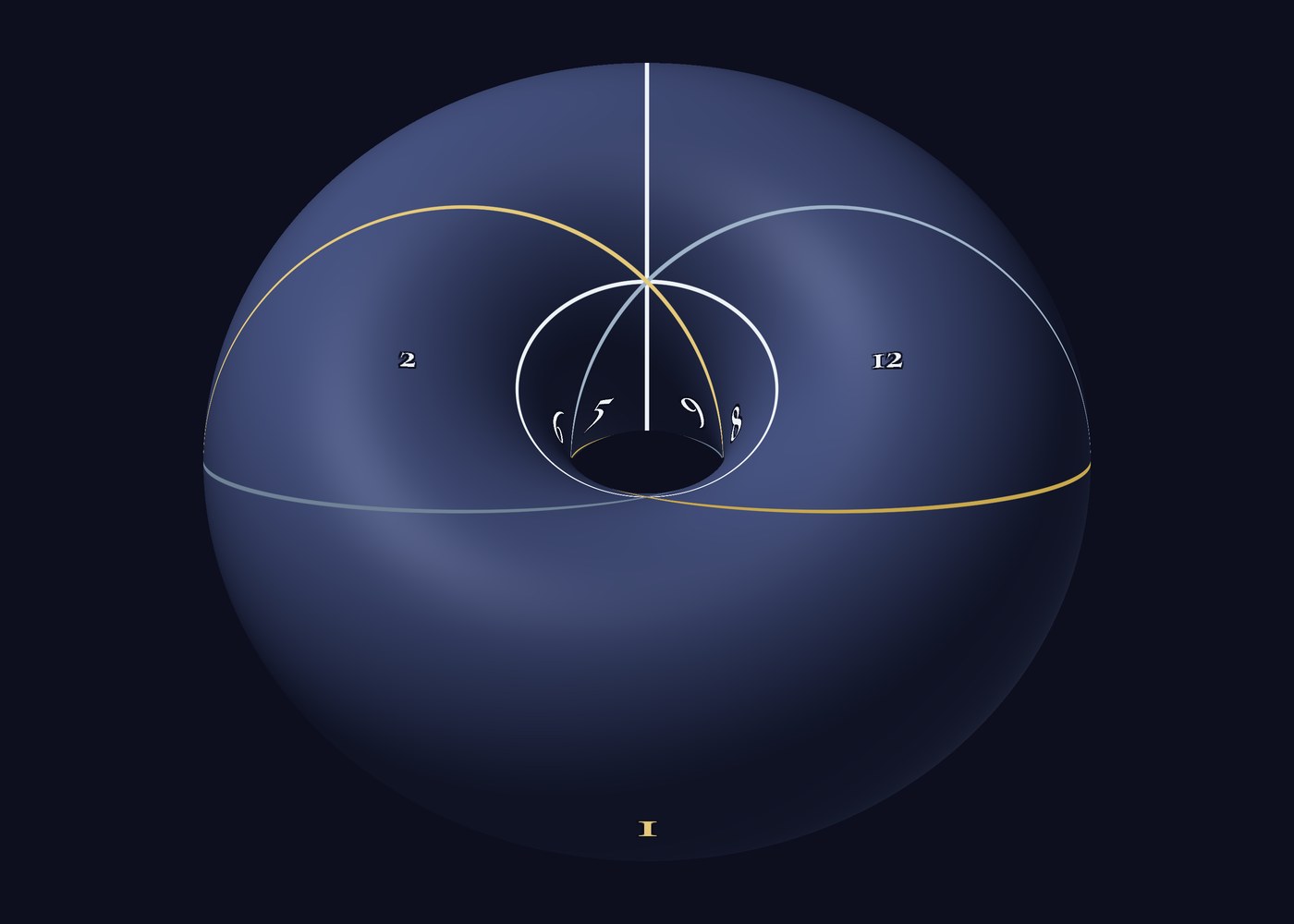
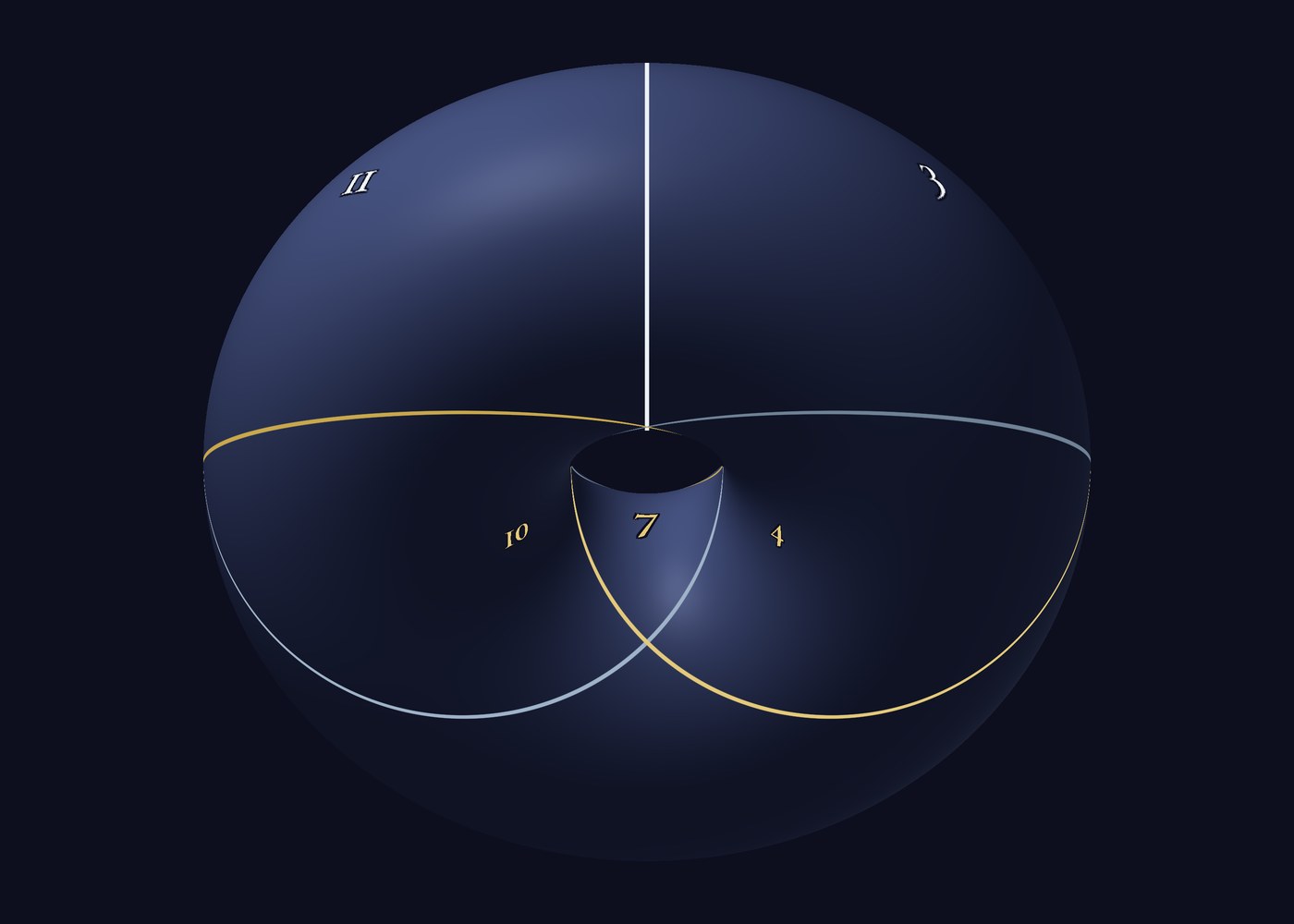
Rolling the sheet into a tube and joining the ends glues the top edge to the bottom and the left edge to the right. The surface this makes is a torus, and because no stretching was involved it is a flat torus, flat in the geometer’s sense that a triangle drawn on it has angles summing to 180°, even though a paper donut in the hand is bent. On it, the chart’s lines close up into six loops. The four edges become two circles, one around the tube and one around the hole. The diagonal that runs from the corner of houses 2 and 3 to the corner of 8 and 9 closes into one loop, and the two diamond edges parallel to it join end to end into a second loop, parallel to the first; likewise for the other diagonal and its two parallel edges.
The twelve houses regroup. The kendras stay four small diamonds, meeting at the centre. The eight corner houses meet at the glued corner, where all four corners of the sheet come together, and form the large diamond of figure 2. Figure 2, in other words, is the donut unrolled and repeated. Two more things happen that I find hard to look away from. The tip of house 1 touches the tip of house 7, and the tip of 4 touches 10: on the donut the opposite kendras kiss. And the still point of 2002 gains a twin. The centre of the chart, where the diagonals cross, and the corner, where they cross again, are the only two places the two diagonals meet on the donut, and the flat torus, which is the same everywhere, does nothing to tell them apart; only the chart’s labels do.
What became of the doughnut universe
The 2008 link was to a Nature news story on a paper by Ralf Aurich, Holger Janzer, Sven Lustig and Frank Steiner in Ulm, who argued from the missing large-angle correlations in the WMAP sky that space might be a flat three-torus of about 5,000 cubic gigaparsecs, roughly 17 gigaparsecs on a side. Planck then looked. Its 2015 topology paper found no matched circles in the sky and set the size of any such torus at no less than 0.97 of the distance to the surface of last scattering, so a torus, if there is one, is not much smaller than the observable universe. The question is not closed: the COMPACT collaboration argued in 2024 that most possible topologies have never actually been tested by the circle searches and has gone back to look. So: allowed, unproven, and larger than my 2002 self imagined. The ṛṣis are patient.
Addendum, September 2026: the circles inside the donut
This went past me yesterday, and it bears directly on the donut above, so here it is, with what I can add to it.
What Hopf found
In 1931 Heinz Hopf wrote down a map from the three-dimensional sphere (the set of points at unit distance from the origin in four dimensions, the surface of the hypersphere) onto the ordinary sphere, with a property nobody had expected. The points of the big sphere that land on any one point of the small one form a circle; any two of those circles are linked, each passing once through the other like two rings of a chain; no two of them touch; and together they fill the hypersphere completely. In the notation that makes it a one-liner, a point of the hypersphere is a pair of complex numbers with
|z1|2 + |z2|2 = 1, and Hopf’s map is (z1, z2) ↦ z1/z2,
a point of the Riemann sphere. Multiply both coordinates by the same unit complex number and the ratio does not change: that one-parameter family is the circle over a point. The paper mattered because it was the first proof that a map between spheres of different dimensions could be essentially knotted, impossible to unwind to a constant, and it opened the whole study of the homotopy groups of spheres.
Why the film looks the way it does
Take the circles that sit over one circle of latitude of the small sphere: together they fill a torus. Over the next latitude, a torus inside or outside the first. So the hypersphere is a nest of tori, one inside another, whose innermost layer shrinks to a single circle and whose outermost opens into a straight line. To draw any of this we do what a mapmaker does with the earth, a stereographic projection, from one point of the hypersphere onto our three-dimensional space. Circles stay circles under that projection, and the tori become the round donuts of the film. The clip in the post is from Dimensions (2008) by Jos Leys, Étienne Ghys and Aurélien Alvarez, chapters 7 and 8, which walk through exactly this and are free to watch.
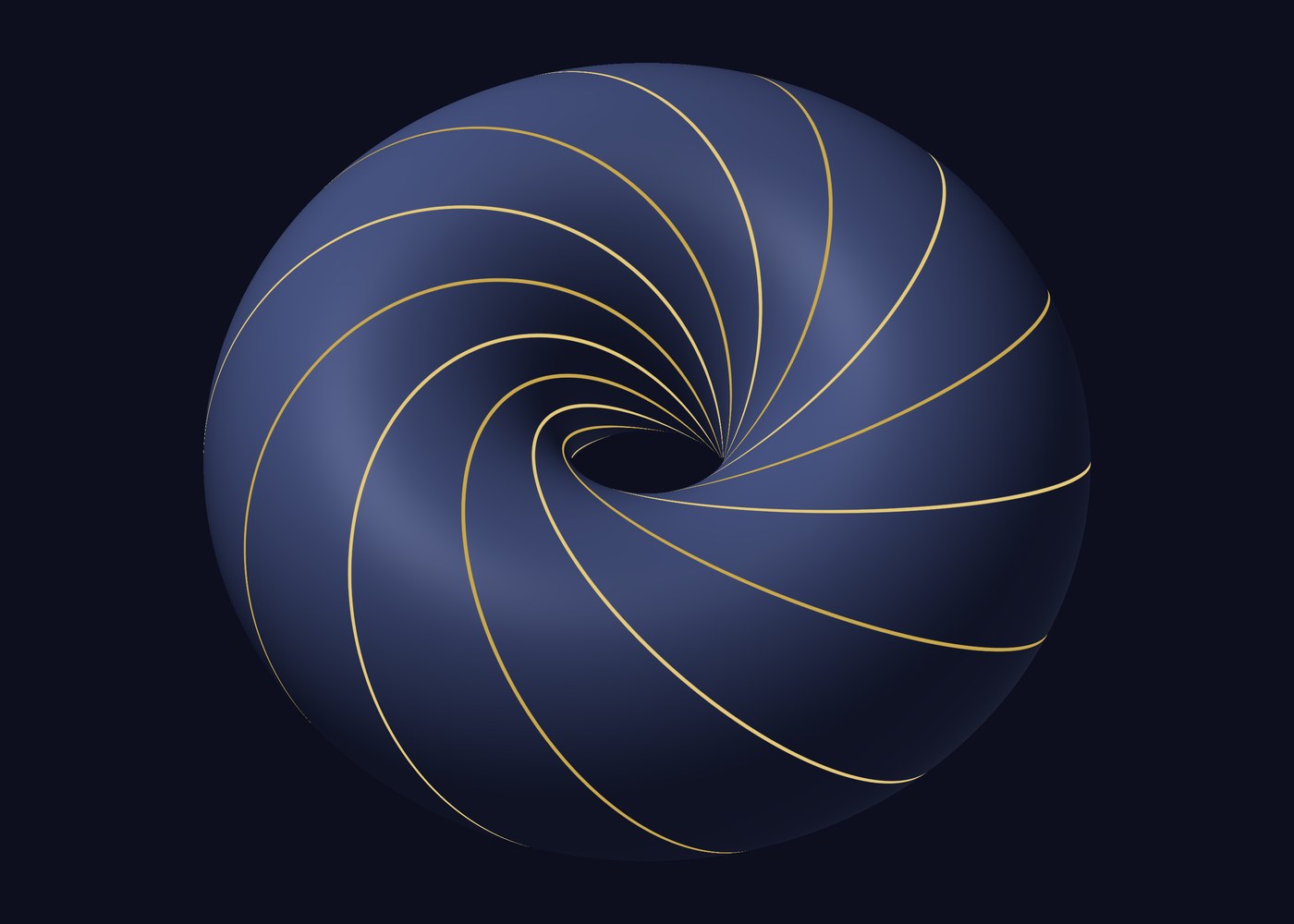
Now the part that made me sit up. The middle torus, the one over the equator of the small sphere, is the Clifford torus, and the Clifford torus is a flat square torus: precisely the object made by gluing the chart’s edges in the section above. On that square torus the Hopf circles are the diagonal lines, the lines of slope one. That is, the main diagonal of the chart, closed up into a loop, is a Hopf circle; the two diamond edges parallel to it, joined end to end, are a second Hopf circle, linked once with the first; and the other diagonal with its two parallel edges gives two circles of the mirror-image fibration, the one obtained by conjugating one coordinate. Figure 3 shows the chart painted onto the actual projected torus. In three dimensions these tilted circles on a donut have a name of their own, the Villarceau circles, known since 1848: they are what you get by slicing a bagel with a plane that touches it at two points.
About the claims in the post
The dates and names are right, with two footnotes. The Penrose line, “an element of the architecture of our world,” I have not managed to find in his published writing, so I leave it as reported. What Penrose certainly did say is that the twisting family of linked circles, Clifford’s parallels of 1873, which are the Hopf circles, is the picture at the root of his twistor theory; it is there in his 1987 essay on the theory’s origins and drawn in The Road to Reality. Eric Weinstein did bring it to Joe Rogan, in episode 1203 of November 2018, calling it the most important object in the universe; Rogan’s reply was not silence but that it looked like a screensaver, which is fair. The silence is the retelling.
The list of places it turns up is sound. A qubit is a pair of complex numbers with |z1|2 + |z2|2 = 1, a point of the hypersphere, and its physical state ignores the overall phase, which is exactly the Hopf circle; what remains is the Bloch sphere. The unit quaternions form the same hypersphere, and sending each quaternion to where it carries one fixed axis is again Hopf’s map, which is why the graphics and robotics people meet it. The Dirac monopole is the same bundle in a physicist’s clothing. The line about large language models stretches the word “geometry” further than I would sign my name to; the rest is fair.
What it does for the chart
I will not pretend the ṛṣis drew Hopf circles. What I will say is narrower than what I wrote in 2002 and, I think, sturdier. The North Indian chart, glued along its edges, is the flat torus, and the flat torus lives most naturally not in our space but in the hypersphere, where it sits as the Clifford torus; there, the chart’s diagonals and diamond become two pairs of linked circles of the two Hopf fibrations, and its two still points, the centre and the corner, are the two crossings of the two diagonals. The medians, which the chart does not draw, would only have been ordinary parallels and meridians. The lines the chart does draw are the interesting ones.
And the 2002 question, how the lagna can move while the chart stays the same, has a cleaner form on the donut. Changing the lagna relabels the twelve regions; it moves nothing. The lines, the two still points, the kiss of 1 and 7, and the links among the circles are untouched by it. A relabelling is a change of where you stand, and the torus, which has no edge and no privileged corner, is the surface on which standing anywhere is allowed. That is what I meant, I now think, by the facets of the crystal flexing.
Related: The Sacred Geometry of Jyotish Redux (the chart as the shadow of the cuboctahedron, with a 3-D model) · Ideal: My Quest for the Kuṇḍalī Solid · How Astrology Exists · Electromagnetic Human.
References
- Heinz Hopf, “Über die Abbildungen der dreidimensionalen Sphäre auf die Kugelfläche,” Mathematische Annalen 104 (1931), 637–665. doi:10.1007/BF01457962
- David W. Lyons, “An Elementary Introduction to the Hopf Fibration,” Mathematics Magazine 76 (2003), 87–98.
- Étienne Ghys, Jos Leys and Aurélien Alvarez, Dimensions: a walk through mathematics (2008), chapters 7–8, “Fibration.” Creative Commons. dimensions-math.org
- W. K. Clifford, “Preliminary Sketch of Biquaternions,” Proceedings of the London Mathematical Society 4 (1873), 381–395 (the Clifford parallels).
- Yvon Villarceau, “Théorème sur le tore,” Nouvelles Annales de Mathématiques 7 (1848), 345–347.
- Roger Penrose, “On the Origins of Twistor Theory,” in Gravitation and Geometry: a volume in honour of Ivor Robinson, ed. W. Rindler and A. Trautman (Bibliopolis, Naples, 1987); and The Road to Reality (Jonathan Cape, 2004), on the Clifford bundle and again in the twistor chapter.
- Eric Weinstein on The Joe Rogan Experience, episode 1203, 15 November 2018.
- Ralf Aurich, Holger S. Janzer, Sven Lustig and Frank Steiner, “Do we live in a ‘small Universe’?” Classical and Quantum Gravity 25 (2008), 125006. arXiv:0708.1420. Reported by Zeeya Merali, “Doughnut-shaped Universe bites back,” Nature News, 23 May 2008. doi:10.1038/news.2008.854
- Planck Collaboration, “Planck 2015 results. XVIII. Background geometry and topology of the Universe,” Astronomy & Astrophysics 594 (2016), A18. doi:10.1051/0004-6361/201525829
- COMPACT Collaboration (Y. Akrami et al.), “Promise of Future Searches for Cosmic Topology,” Physical Review Letters 132 (2024), 171501. arXiv:2210.11426
- Harish Johari, The Yoga of Snakes and Arrows: The Leela of Self-Knowledge (Destiny Books, 2007), the game linked in the 2008 note.
- Eron (@0xEronn), post of 28 September 2026, embedded above. x.com/0xEronn/status/2104556635414770024
Figures 1 and 2 are drawn to scale; figures 3 and 4 are computed renderings of the stereographic image of the Clifford torus (major radius √2, minor radius 1), with the chart’s lines mapped onto it as the curves α − β = const and α + β = const. The 2002 text’s original link on “good further simple background” did not survive the site’s migration and has been replaced.