First published 9 May 2012 · revised and expanded 29 September 2026: the magnetosphere drawing, lost in the move from the old site, restored from its backup; the pictures put back where the text refers to them; and a note added on what the torus is, and where it leads. The 2012 text is kept as it was, apart from spelling.
Meditation is a wonderful thing.
I’ve lately begun to feel the connection of the suṣumnā nāḍī to my crown cakra above and my root cakra below. A magnetosphere phenomenon happens. In other words, the first picture plus meditation is the second picture.
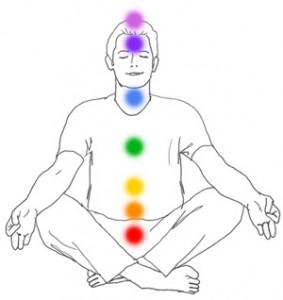
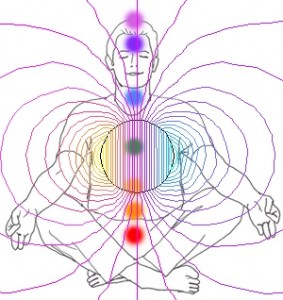
A human in meditation looks like a magnetosphere in the shape of a torus, the shape of the universe.
This might explain why groups of meditators practicing together “cohere” enough to change the environment.
Don’t believe in macroscopic coherence? Here is mainstream proof.
Note how the heart is the core of the torus.
Did you know that the earth’s magnetosphere correspondingly looks like a human?
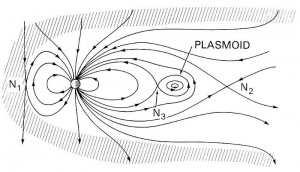
Plus, by extension, there is this: Rattling Earth’s Force Field, a truly awesome video that basically explains the foundations of Vāstu.
A note added in 2026
Fourteen years on, I know a good deal more about what that shape is, and I have just come from writing about the most beautiful torus mathematics owns, in the hypercubes essay. Here is what I would add.
The torus every magnet makes
The torus in the second picture is not a property of meditators, or of hearts. It is what the field of every dipole looks like: a bar magnet, a loop of current, the Earth. Each field line leaves one pole, swings out, and returns to the other, a flat loop lying in its own meridian plane, and the loops of all the planes together make a surface pinched at the axis, a torus whose hole has closed to a point (figure 3). For the Earth, a line that crosses the equator at L Earth-radii follows
r = L sin2θ,
McIlwain’s shell, and the shells nest like the skins of an apple around the axis. The axis of the drawing is the suṣumnā of the picture.
The heart really does make one. It is a bundle of moving charge, and its magnetic field, first picked up in 1963 by Baule and McFee with a pair of coils on the chest, is the strongest rhythmic magnetic field the body produces, on the order of a hundred times the brain’s, and is measured today as the magnetocardiogram. So the geometry of my 2012 picture is right, with one liberty I did not know I was taking: the heart’s dipole leans. The mean electrical axis of the heart runs from the right shoulder toward the left hip, about sixty degrees below the horizontal in most people, so the heart’s own torus sits tilted about the body’s, its circles slanting across the chest rather than around the spine. The upright torus of the drawing is the body’s axis with the heart’s field idealised onto it, which I still think is the right picture to meditate on, as long as one knows which liberty it takes.
The Earth’s, and the plasmoid
The Earth’s field would be figure 3 if the Earth were alone. It is not: the solar wind squashes the sunward side to about ten Earth-radii and draws the night side out into a tail hundreds of radii long, which is the shape in figure 2. The drawing’s three N’s are neutral lines, places where the stretched field lines pinch and reconnect, and the plasmoid is a blob of the tail let go downstream when they do. The video I linked is that process in motion, the whole shell shivering as the wind gusts. Whether it explains Vāstu I will leave as I left it: a dwelling that Vāstu orients to the cardinal directions is a dwelling oriented to this field, whatever else the orientation does.
Where the torus leads
Since 2012 I have learned that there are two kinds of torus made of loops, and that the difference is the whole story. The dipole’s is a torus of loops that never link. Each lies flat in its own plane, and two of them, in two planes, pass by one another without catching (figure 4, left). The other kind is the one in the hypercubes essay: the torus that the Hopf fibration fills with circles, in which every circle is linked with every other, once, like two rings of a chain (figure 4, right). There the loops are not flat and not in planes; each winds once around the tube and once around the hole, and holds every other.
It is not an idle distinction, because physics has fields of the second kind. In 1989 Antonio Rañada found a solution of Maxwell’s equations in empty space, no charges and no currents, light and nothing else, in which every magnetic line is a Hopf circle and every electric line is one too, the two families threaded through each other: the electromagnetic knot, now called the hopfion. Irvine and Bouwmeester showed in 2008 how a beam of light could carry one, and Kedia and colleagues tied further knots into it in 2013. In the last five years magnetic hopfions have been made and imaged in the laboratory, in stacked magnetic films by Kent and colleagues in 2021 and, as rings, in a chiral magnet by Zheng and colleagues in 2023. And in a plasma, Smiet and colleagues showed in 2015, a tangled magnetic field left to itself relaxes toward exactly this: nested tori of linked lines around a core ring. Figure 5 is that field, cut open.
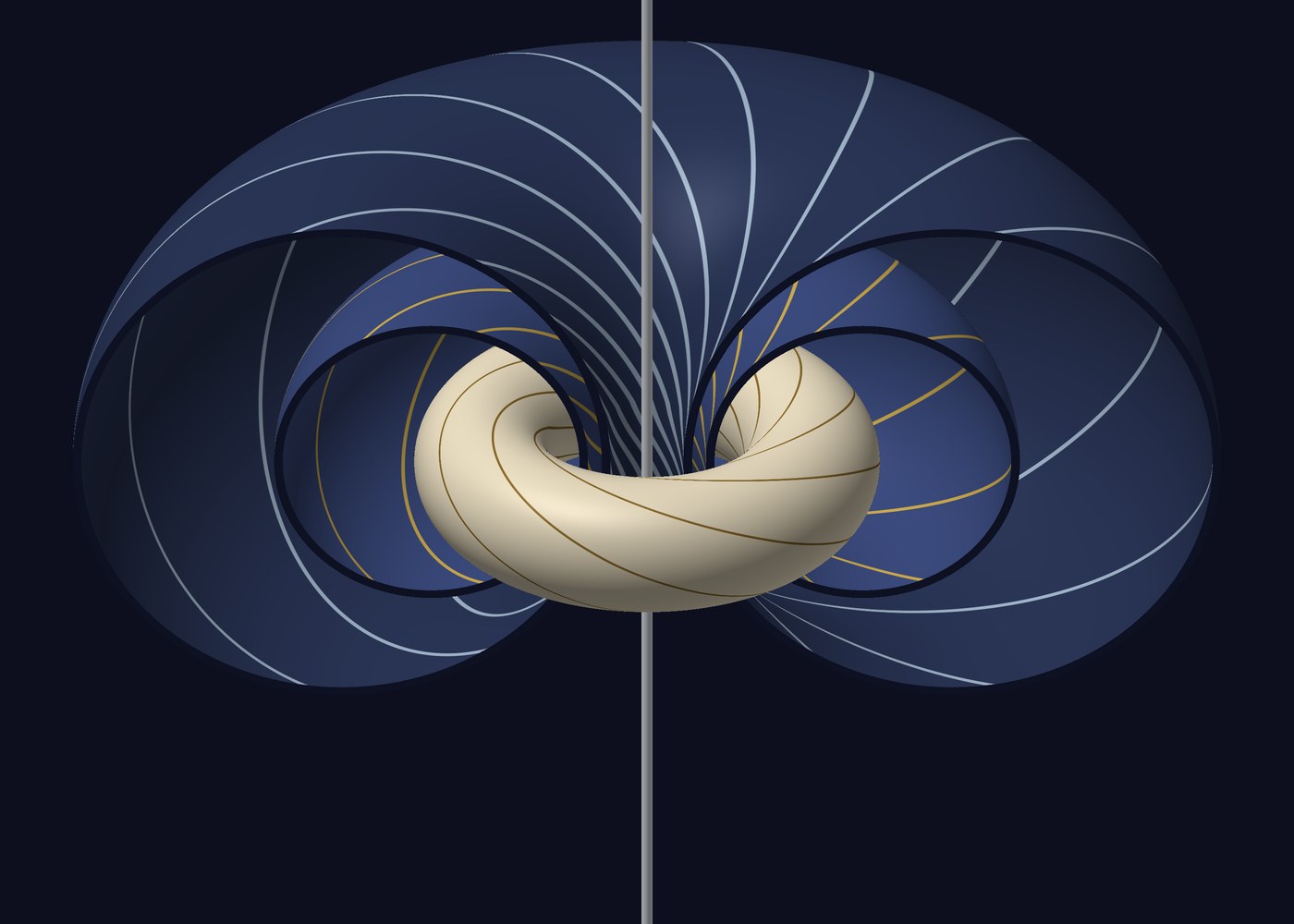
Set the two pictures side by side. The dipole has an axis and an apple of flat loops around it. The hopfion has an axis, a core ring, and between them an onion of tori, each woven from circles that hold one another. The second is the first with a twist put in, and the twist is what makes the loops link. That twist is the quantity the plasma people call helicity, and it is conserved: a field that has it cannot shed it by relaxing, which is why the tangle settles into the onion rather than into nothing.
About coherence
The diamonds were real. In 2011 Ian Walmsley’s group entangled a single quantum of vibration between two diamonds three millimetres across and fifteen centimetres apart, at room temperature, and the Nature report I linked still stands. What it shows is that entanglement is not confined to the cold and the small. What it does not show is that people entangle. The group-meditation studies, I should say plainly, are contested, and I will not pretend the diamonds settle them. The leap of 2012 stands as a leap, and I am content to have it seen as one.
So
What I felt on the cushion was an axis and a donut. Fourteen years and a good deal of geometry later, I can say what that shape is. It is the shape of every field with an axis, the heart’s included; and it is one twist away from the most beautiful object mathematics has, the torus in which the loops hold each other. Whether that twist is there in a meditating body I have no way to measure. That it is there in light, in magnets and in plasma, I can now cite.
Related: On the Jyotishical Arrangement of Hypercubes (the chart as a torus, and the Hopf fibration) · The Sacred Geometry of Jyotish Redux · How Astrology Exists.
References
- G. Baule and R. McFee, “Detection of the magnetic field of the heart,” American Heart Journal 66 (1963), 95–96.
- C. E. McIlwain, “Coordinates for mapping the distribution of magnetically trapped particles,” Journal of Geophysical Research 66 (1961), 3681–3691.
- K. C. Lee et al., “Entangling macroscopic diamonds at room temperature,” Science 334 (2011), 1253–1256. Reported by Philip Ball, “Entangled diamonds vibrate together,” Nature News, 1 December 2011. doi:10.1038/nature.2011.9532
- A. F. Rañada, “A topological theory of the electromagnetic field,” Letters in Mathematical Physics 18 (1989), 97–106; “Knotted solutions of the Maxwell equations in vacuum,” Journal of Physics A 23 (1990), L815–L820.
- W. T. M. Irvine and D. Bouwmeester, “Linked and knotted beams of light,” Nature Physics 4 (2008), 716–720. doi:10.1038/nphys1056
- H. Kedia, I. Bialynicki-Birula, D. Peralta-Salas and W. T. M. Irvine, “Tying knots in light fields,” Physical Review Letters 111 (2013), 150404. arXiv:1302.0342
- N. Kent et al., “Creation and observation of Hopfions in magnetic multilayer systems,” Nature Communications 12 (2021), 1562. doi:10.1038/s41467-021-21846-5
- F. Zheng et al., “Hopfion rings in a cubic chiral magnet,” Nature 623 (2023), 718–723.
- C. B. Smiet, S. Candelaresi, A. Thompson, J. Swearngin, J. W. Dalhuisen and D. Bouwmeester, “Self-organizing knotted magnetic structures in plasma,” Physical Review Letters 115 (2015), 095001. doi:10.1103/PhysRevLett.115.095001
- A. M. Kamchatnov, “Topological solitons in magnetohydrodynamics,” Soviet Physics JETP 55 (1982), 69–73.
- Renay Oshop, “On the Jyotishical Arrangement of Hypercubes” (2002; revised 2026), for the Hopf fibration, the Clifford torus, and the film Dimensions.
Figures 3 and 4 are computed line drawings (dipole lines r = L sin²θ; Hopf circles on the Clifford torus). Figure 5 is a computed rendering: the stereographic images of the Hopf fibres over the latitudes 45°, 90° and 120° of the sphere, as thin shells, the outer two cut by a meridian plane. Figures 1 and 2 are the 2012 pictures.