First published 21 April 2011 · reconsidered and extended 18 October 2026. The 2011 text stands as it was, apart from spelling, the paragraphing the old site had lost, a source line under the quoted passage, and one link repaired. The one picture is placed where the text refers to it, and the moving picture, a three-and-a-half-megabyte film of a turning hypercube which the text points to “towards the bottom,” is now drawn live on the page where the text first calls for it. Everything after the rule is mine, of 2026.
While watching a lecture on Quantum Field Theory, I saw that perhaps it yields clues as well to our attraction to triads and the number nine, and yet another reason why three cubed times two squared = 108 is a holy number. Along the way I saw some predictive power to my ideas.
With ten minutes of research I saw realization of some of the predictions and thereby through junior high school math, a suggestion of strong support for the necessity and value of astrology.
Consider the following scales:
| atom | = 10−9 meters in diameter |
| an electron/quark | = 10−18 meters in diameter |
| the Grand Unified Field | = 10−27 meters in diameter |
I saw a very simple progression of scales: atom as the billiard ball, the qualities of that point in space (1 dimension) gets squared to give us the power of the electron scale, and cubed to give us the scale of the Grand Unified Field.
What if we build a simple 3-D space for the mathematics of these phenomena?
We may or may not be living in that math space so let’s explore it.
10−9 meters is atomic, of the scale of the perceived, called chandas or the meter of sound in meditation. The meter of sound in Sanskrit and Yogic theory can create objects. Atoms make up what we hear, feel, see, taste, and smell.
10−18 meters is the square, of the scale of the perceiving, called devatā in meditation. I like that devatā is also Sanskrit for an artist, someone who approaches the Deva of God, through the senses. Electrons and their quarky ilk give us something by which we may hear, feel, see, taste, and smell.
With the 10−27 meters, the square becomes a cube. This is the realm of the ṛṣi, the perceiver. It is the ultimate state of discrimination, by physicists’ account.
Of a cube there are of course 8 vertices and 12 edges.
If edges are types of quantum particles and vertices are types of quantum fields, then this model describes the 12 types of fermions and 8 bosons to be found by any particle accelerator as well as their interchangeability, the 3 colors, and supersymmetry. (See the moving picture towards the bottom of this post.)
This mathland has other predictive properties.
It suggests to me that the scale of earth is 1/10−9 = 109 meters, the inverse of the atom.
A galaxy would be 1/10−18 meters = 1018 meters, the inverse of electrons and quarks.
A universe should be 1 divided by 10−27 = 1027 meters, the inverse scale of the Grand Unified Field.
Let’s look at the actual sizes (with the help of Wikipedia) of the actual diameters.
The Earth = approximately 1.2 × 10⁷ meters, so that’s a fail.
I was concerned about this until I remembered a sūtra from Patañjali, something about how if the SUN is known, then you know the Universe. (Replace “known” with “saṁyamāt” if you know Sanskrit.)
A Sun seems more like the inverse of an atom anyway.
Sure enough the scale of the Sun is 109 meters.
The scale of the galaxy is 1018 meters.
The scale of the universe is 1027 meters!
Why is a meter used, besides that it gives us the nice numbers of units of 9? Well, it is also a scale of the human body. Actually if a conscious human starts at about age 4 and goes to adulthood, the size of the body is on the lower range of 100 meters; i.e. 1.2 to 2 × 100 meters. That zero is very important. (Remember that 10 to the zero power is one.) It is the inflection point in going from macro to micro.
Even more interesting the units of scale of the Sun and Galaxy and Universe are presently around 1.2 × their respective orders of magnitude. Perhaps they only have expansive properties up to 2 and then, well, that is the end of the cycle.
There is another predictive quality of this paradigm, that of the construction of time, from space.
Place the micro cube (10−9, 10−18, 10−27) inside the macro cube of 109, 1018, and 1027.
What you get is the 3-D representation of a hypercube, the standard representation of 4D space-time.
Its movement in time is the moving image below.
The macro cube might be what is first inside; it doesn’t really matter to get you the hypercube mathematically, as you can see.
Upon hearing from a friend that the above looks like a snake eating its tail, a wealth of imagery came to mind, especially the story of the ouroboros:
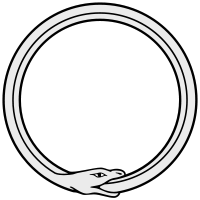
After an exaltation of the simplest Platonic form (a cube), Plato speaks to us again:
Plato described a self-eating, circular being as the first living thing in the universe—an immortal, mythologically constructed beast.
The living being had no need of eyes when there was nothing remaining outside him to be seen; nor of ears when there was nothing to be heard; and there was no surrounding atmosphere to be breathed; nor would there have been any use of organs by the help of which he might receive his food or get rid of what he had already digested, since there was nothing which went from him or came into him: for there was nothing beside him. Of design he was created thus, his own waste providing his own food, and all that he did or suffered taking place in and by himself. For the Creator conceived that a being which was self-sufficient would be far more excellent than one which lacked anything; and, as he had no need to take anything or defend himself against any one, the Creator did not think it necessary to bestow upon him hands: nor had he any need of feet, nor of the whole apparatus of walking; but the movement suited to his spherical form was assigned to him, being of all the seven that which is most appropriate to mind and intelligence; and he was made to move in the same manner and on the same spot, within his own limits revolving in a circle. All the other six motions were taken away from him, and he was made not to partake of their deviations. And as this circular movement required no feet, the universe was created without legs and without feet.
In Gnosticism, this serpent symbolized eternity and the soul of the world.
The Ouroboros often represents self-reflexivity or cyclicality, especially in the sense of something constantly re-creating itself, the eternal return, and other things perceived as cycles that begin anew as soon as they end (the mythical phoenix has a similar symbolism). It can also represent the idea of primordial unity related to something existing in or persisting before any beginning with such force or qualities it cannot be extinguished. The ouroboros has been important in religious and mythological symbolism, but has also been frequently used in alchemical illustrations, where it symbolizes the circular nature of the alchemist’s opus. It is also often associated with Gnosticism, and Hermeticism.
— Wikipedia, “Ouroboros,” as it read in April 2011; the long passage is Plato, Timaeus 33c–34a, in Jowett’s translation.
What is neat too about this approach though is that the “boiling of the quantum field” is on the outside and suggests as the string theorists do that there is bubbling of membranes between universes.
Thus time is accounted for as a function of macro AND micro space.
Just as important, the axiom of “As above, so below” is proven.
| Sun | ⇔ | Atom |
| Galaxy | ⇔ | Electron |
| Universe | ⇔ | Quantum Field |
Therefore, so is proven the necessity and legitimacy of astrology.
Thanks for reading.
Fifteen years on
I have left the piece above as I wrote it in the spring of 2011, spelling aside, down to the two sentences near the end that declare the maxim and astrology proven, which I would not write now. It is an early piece, and the one whose title promises the most. I have now checked the rungs. Here is what holds, what does not, whose company the argument was unknowingly keeping, and what I think it was really reaching for.
The ladder, measured
The 2011 ladder has rungs every nine powers of ten: 10−27, 10−18, 10−9, then the human at 100, then 109, 1018, 1027 metres, and the claim is that the world has something sitting on each rung, with the small and the large mirrored about us. Figure 3 lays the measured sizes of things along two rulers, the small world above and the large below, aligned so that 10−k sits over 10k. The rungs are gold; the world is cream.
Two rungs of the six hold outright. The Sun is 1.39 × 10⁹ metres across, a little more than its power of ten; the observable universe is about 8.8 × 1026, a little less than its rung of 1027 (0.88 of it, not the 1.2 the 2011 text claimed); each is within a tenth of a decade of where the ladder put it. And the human at the centre is, as advertised, a metre or two. Two good rungs and a centre, and they are real.
The atom is a tenth of a nanometre, not a nanometre: a hydrogen atom is 1.06 × 10⁻¹⁰ metres across, and the biggest atoms are five times that. The rung at 10−9 is the width of a small molecule; the DNA helix, at two nanometres, sits on it almost exactly. So the atom is one power of ten off, which on a ladder whose rungs are nine apart is a near miss, and the mirror of Sun and atom is a mirror with a step in it: 109.1 against 10−10.0.
The electron has no size that anyone has been able to measure. Every experiment that has looked finds it point-like, smaller than 10−22 metres, and the quarks the same to the reach of the colliders, under about 4 × 10⁻¹⁹. So there is nothing “10−18 metres in diameter.” There is, though, a real length very near that rung, and it is a better one than the one I named: 10−18 metres is about the reach of the weak force, the distance that goes with the energy of the Higgs field, ħc divided by 246 GeV, which comes to 8 × 10⁻¹⁹ metres. Below that distance the weak force and electromagnetism are one force; above it they are two. That is a threshold worth a rung, and the 2011 text does not name it.
The “Grand Unified Field” at 10−27 metres I cannot account for from any physics; it is simply the cube of 10−9, which is what the paragraph that follows it says it is. The grand-unification energy the physicists mean is around 1016 GeV, which is a length of about 10−32 metres, and the Planck length, where the ladder of the physical world runs out, is 1.6 × 10⁻³⁵. Nothing is at 10−27. And the galaxy is wrong by more than the atom: the Milky Way’s disc is about a hundred thousand light-years, 1021 metres, a thousand times the rung at 1018, which is a hundred light-years, the size of a globular cluster.
So: of the three mirrored pairs, Sun and atom hold to within a step; galaxy and electron do not, though each side of the pair has something real near it; universe and quantum field hold on the large side and have nothing on the small. The ladder was built by picking three numbers for the small world and inverting them, and two of the three numbers were not the world’s. I was more right about the large than the small, which is the reverse of what one would expect from a lecture on quantum fields, and which tells me the large numbers were the ones I had actually looked up.
The middle of the world
The ladder has the human at 100 because the ladder was built symmetrically around 100: that is a property of the construction, not a discovery about us. The world’s own ladder is not symmetric about a metre. It runs from the Planck length to the edge of the observable universe, 10−34.8 to 1026.9 metres, sixty-two powers of ten, and its middle, the geometric mean of its two ends, is 10−3.9 metres: a tenth of a millimetre. That is not the size of a person. It is the size of a human egg cell, the largest cell in the body and the only one that can be seen with the naked eye, a hundred to a hundred and twenty microns across. The middle of the measurable world, in the only sense of “middle” that a logarithmic ladder admits, is the single cell every one of us began as. I did not go looking for that, and I do not know what to do with it except to set it down, mark it on the ruler, and send the reader to the ten months and the twenty-seven stations that follow from it.
Dirac had the same itch
The argument has a distinguished history, and a cautionary one, which the 2011 piece does not mention. In 1937 Paul Dirac took up a coincidence that Hermann Weyl had remarked on and Arthur Eddington had been pressing: two very large pure numbers in physics come out nearly equal. The electric force between a proton and an electron is about 2.3 × 1039 times the gravitational force between them; and the age of the universe, measured in the natural unit of atomic time, the time light takes to cross the classical radius of an electron, is between four and five times 1040. Two unrelated numbers, both near 1040; and the number of protons in the observable universe is near the square of that, 1080. Dirac said what I said: this is no accident, and the small must be tied to the large. He called it the Large Numbers Hypothesis.
| Dirac’s numbers | value |
|---|---|
| electric force ÷ gravitational force, proton and electron | 2.3 × 1039 |
| age of the universe ÷ the light-crossing time of the classical electron radius | 4.6 × 1040 |
| the Hubble radius, c/H0, ÷ classical electron radius | 4.9 × 1040 |
| protons in the observable universe | about 1080 |
The difference between Dirac and me is what he did next. If the two numbers are equal because they are tied, and one of them, the age of the universe, grows with time, then the other must grow too, and the only way it can is for gravity to weaken: Dirac predicted that G falls as the universe ages, by about seven parts in a hundred billion a year. That is a measurable prediction, and it has been measured. Bouncing laser light off the reflectors the Apollo astronauts and the Lunokhod rovers left on the Moon, and tracking the Moon’s orbit over nearly fifty years, gives a yearly change in G, relative to G, of (7 ± 8) parts in 1014, which is to say none, to a precision a thousand times finer than what Dirac needed. The Large Numbers Hypothesis is dead, and it died well: it made a claim about the world that the world could answer.
This is the lesson I would now draw from my own ladder. A coincidence of numbers is a question. It becomes an answer when it predicts something that was not used to build it, and the prediction is checked. The 2011 piece did make predictions, the sizes of the Sun, galaxy and universe, and I checked them in ten minutes and reported the hits; what I did was let no miss stand: when the Earth failed I swapped in the Sun, and the galaxy, which also failed, I reported as a hit, and I did not notice that two of my three starting numbers were unmoored. The earthquake essay was an attempt to do it Dirac’s way; this note is another.
The cube and the particles
“The 12 types of fermions and 8 bosons” was a count I liked, and I should say how it stands. The twelve fermions are right: six quarks and six leptons, three generations of four. The bosons are not eight. The forces are carried by twelve, eight gluons and the W+, W−, Z and photon, and in July 2012, fourteen months after I posted this, the thirteenth was found at CERN, the Higgs. Supersymmetry, which the cube was also to have described, has not appeared in fifteen years of looking at the Large Hadron Collider. A cube has 8 vertices, 12 edges and 6 faces; a hypercube has 16 vertices, 32 edges, 24 faces and 8 cells. Neither is the Standard Model’s table of contents. The count was a coincidence, and the Higgs spoiled it in the summer of 2012.
The cube inside the cube
What does hold, and holds better than I knew, is the picture. A cube drawn inside a cube with their corners joined is the standard way of drawing a hypercube in three dimensions, the way a square inside a square with joined corners draws a cube on paper; the inner cube is the far one, shrunk by perspective along the fourth axis. And the remark I made in passing, that “it doesn’t really matter” which cube is inside, is not a shrug. It is a theorem about the figure. Turn the hypercube through a half turn in the plane of the fourth axis and one of the first three, and the inner cube comes out and becomes the outer while the outer goes in. Figure 1 does it in front of you. The exchange of micro and macro, the thing the whole 2011 argument was about, is literally a rotation of this figure, a symmetry it has. “As above, so below” is not something the hypercube proves about the world. It is something the hypercube is.
One correction of language. A hypercube is a figure in four dimensions of space, and the fourth dimension of space-time is not a fourth direction one can turn a figure into; the drawing is a picture of four space-like axes, not of time. As an image for time made out of space it still pleases me, and the ouroboros fits it exactly: the figure that turns itself inside out is the serpent that eats its tail. But it is an image. And the sixteen corners of the hypercube have one more property that belongs here: taken as points (±1, ±1, ±1, ±1), they all lie on the Clifford torus, x12 + x22 = x32 + x42 = 2, the torus that the hypercubes essay builds the chart on and that the Hopf circles of the Electromagnetic Human essay fill. The three essays are one figure seen from three sides.
Ṛṣi, devatā, chandas
The three Sanskrit words I hung on the three rungs deserve a note, because they are better than the rungs. Every Vedic mantra, when it is taken up for use, is introduced by three things: its ṛṣi, the seer who received it; its devatā, the deity it addresses; and its chandas, the metre it is set in. The Anukramaṇīs, the ancient indexes of the Ṛgveda, list these three for every hymn, and the formula survives in the pūjā preamble that begins asya mantrasya … ṛṣiḥ, … chandaḥ, … devatā. The reading of them as the knower, the process of knowing and the known, perceiver, perceiving and perceived, is the teaching of Maharishi Mahesh Yogi’s Vedic Science, and that, I think, is the current the 2011 paragraph was swimming in. It is a modern reading and a good one; it is not what the words meant to Śaunaka. One thing in the 2011 paragraph is simply wrong: devatā does not mean an artist in Sanskrit, in Monier-Williams or anywhere I have been able to find. I have let the sentence stand with this note against it.
So
“As above, so below” is from the Emerald Tablet, an Arabic text of the eighth or ninth century that reached Latin in the twelfth: quod est inferius est sicut quod est superius, what is below is as what is above, to work the wonders of the one thing. Newton translated it into English in his own hand. It is the maxim every astrologer lives by, and in 2011 I wrote that a ladder of exponents had proven it, and that astrology’s legitimacy followed. I would not write either sentence now. Two matching exponents do not prove a maxim; and astrology does not rest on the maxim anyway. Jyotiṣa makes a claim about the world, that the configuration of the sky carries information about the moment, and a claim about the world is established the way Dirac’s was tested and the way the earthquakes were: by saying in advance what should be found, and looking. That is slower than a ladder and less beautiful, and it is the only way I know that the word “exists” can be earned.
What I keep from 2011 is the figure. A cube within a cube, turning in a direction we cannot point to, so that the inner becomes the outer and the small the large, with every corner on the one torus; and, on the measured ladder, at its exact middle, a cell a tenth of a millimetre across from which a person comes. If that is not how astrology exists, it is at least how the wish for it does, and the wish is older than Dirac, older than the Emerald Tablet, as old as the first person who looked up and felt looked at.
Related: On the Jyotishical Arrangement of Hypercubes (the chart as a torus; the Hopf fibration) · Electromagnetic Human (the torus of the heart and the Earth) · The Sacred Geometry of Jyotish Redux · Yoga Sūtra III.26, the Sun and the worlds · The Circle of Varuṇa (a prediction, tested).
References
- Sizes used in Figure 3: hydrogen atom 1.06 × 10⁻¹⁰ m (twice the Bohr radius); proton charge diameter 1.68 × 10⁻¹⁵ m (CODATA 2018 radius 0.841 fm); DNA helix 2 nm; human oocyte 100–120 µm; Earth 1.274 × 10⁷ m; Sun 1.391 × 10⁹ m; Milky Way stellar disc about 105 light-years; observable universe 8.8 × 1026 m. The weak-force reach is ħc/246 GeV = 8.0 × 10⁻¹⁹ m; the grand-unification length ħc/(2 × 1016 GeV) ≈ 10−32 m; the Planck length 1.616 × 10⁻³⁵ m. Electron size bound: H. Dehmelt, “A single atomic particle forever floating at rest in free space: new value for electron radius,” Physica Scripta T22 (1988), 102–110 (below 10−22 m). Quark size bound: ZEUS Collaboration, “Limits on the effective quark radius from inclusive ep scattering at HERA,” Physics Letters B 757 (2016), 468–472 (below 4.3 × 10⁻¹⁹ m).
- P. A. M. Dirac, “The cosmological constants,” Nature 139 (1937), 323; “A new basis for cosmology,” Proceedings of the Royal Society A 165 (1938), 199–208.
- F. Hofmann and J. Müller, “Relativistic tests with lunar laser ranging,” Classical and Quantum Gravity 35 (2018), 035015: Ġ/G = (7.1 ± 7.6) × 10−14 per year. Dirac’s hypothesis needs about −7 × 10⁻¹¹ per year (−1/t with t = 13.8 billion years).
- ATLAS Collaboration, “Observation of a new particle in the search for the Standard Model Higgs boson with the ATLAS detector at the LHC,” and CMS Collaboration, “Observation of a new boson at a mass of 125 GeV with the CMS experiment at the LHC,” Physics Letters B 716 (2012), 1–29 and 30–61.
- Plato, Timaeus 33c–34a, tr. Benjamin Jowett (1871), as quoted in Wikipedia’s “Ouroboros” in April 2011.
- The Emerald Tablet (Tabula Smaragdina): the Arabic in the Kitāb sirr al-khalīqa (8th–9th century); the Latin quod est inferius est sicut quod est superius from the twelfth-century translations; Isaac Newton’s English rendering, Keynes MS 28, King’s College, Cambridge.
- Patañjali, Yoga Sūtra III.26, bhuvanajñānaṁ sūrye saṁyamāt, “from saṁyama on the Sun, knowledge of the worlds”; see the sūtra page.
- On ṛṣi, devatā and chandas: the Sarvānukramaṇī of Kātyāyana, which indexes the seer, deity and metre of every Ṛgvedic hymn, and the Bṛhaddevatā of Śaunaka, on the deities; Monier-Williams, A Sanskrit-English Dictionary (1899), s.v. devatā. The knower–knowing–known reading: Maharishi Mahesh Yogi, Maharishi Vedic University: Introduction (1994).
- Renay Oshop, “On the Jyotishical Arrangement of Hypercubes” (2002; revised 2026) and “Electromagnetic Human” (2012; revised 2026), for the Clifford torus and the Hopf circles.
Figure 1 is drawn and turned on the page: the sixteen corners (±1, ±1, ±1, ±1) rotated in the x–w plane, projected to three dimensions by perspective along w and then to the page. Figure 3 is computed from the sizes in reference 1. Figure 2 is the 2011 picture.