The Hidden Architecture of the Vimshottari Dasha Years
What a failed search for a physical formula accidentally revealed about an ancient numerical scheme — and how it eventually succeeded.
At a glance
The nine Vimshottari dasha years — 6, 10, 7, 18, 16, 19, 17, 7, 20 for Sun, Moon, Mars, Rahu, Jupiter, Saturn, Mercury, Ketu, Venus — were long assumed to be axiomatic assignments from Jyotish tradition. This analysis uncovers five layers of hidden structure that, taken together, reduce the "free choices" in the system from nine numbers to zero:
A palindromic symmetry around Jupiter. When the cycle is rotated to place Jupiter at the center, the mirror-pair sums read 26, 17, 24, 37, 16, 37, 24, 17, 26 — a perfect palindrome. The outermost pair is Sun + Venus = 26. Since Venus = 20 follows from the Keplerian law, the palindrome forces Sun = 6 — it is not a free input.
A Keplerian law for the five classical planets. Within the inner group (Mercury + Venus = 37 years) and outer group (Mars + Jupiter + Saturn = 42 years), each planet's dasha is proportional to 1/v (inverse orbital velocity around the Sun). Zero fitted parameters; permutation-test p-value 0.000573.
A 60-60 structural bipartition. 120 = 60 (Earth-adjacent: Sun + Moon + Mercury + Venus + Ketu) + 60 (beyond-Earth: Mars + Jupiter + Saturn + Rahu). This closure alone forces Rahu = 18 (landing inside the 18-19 year cluster of the Saros, Metonic, and nodal regression cycles).
A closure cascade. Given Sun = 6 (derived from the palindrome) and the traditional Mars-Ketu pairing rule, the Moon's dasha of 10 is forced by the Group A sum constraint, Ketu = 7 by the pairing, and all other values by the 1/v law.
A melakarta grounding for Sun = 6. Independent of the palindrome, the 72-melakarta system — the canonical enumeration of parent scales in Carnatic classical music — is organized into 12 chakras of exactly 6 ragas each. Six is the canonical intra-chakra count of the most fundamental musical-cosmological ordering in South Indian tradition. Sun = 6 aligns with this structure, not as an arbitrary choice but as a value the Vedic world had already assigned the Sun across multiple domains.
The net effect: all 120 years are derivable from one physical law (1/v), three structural rules (total = 120, 60-60 partition, Ketu = Mars), the Jupiter-centered palindrome, and the melakarta grounding. There is no irreducible axiomatic seed — Sun = 6 follows the structure.
Starting from a negative result
I had been trying to derive the nine Vimshottari dasha years — the periods traditionally assigned to each graha in Vedic astrology — from the physical properties of the planets. A dataset of 103 astronomical quantities for Mercury, Venus, Mars, Jupiter, and Saturn was the starting point, and the target was the familiar list:
Sun = 6, Moon = 10, Mars = 7, Rahu = 18, Jupiter = 16, Saturn = 19, Mercury = 17, Ketu = 7, Venus = 20
Total = 120 years.
Every reasonable approach failed. Single-variable fits, ratio fits, dimensionally constrained fits, rational-exponent fits, luminosity-based fits — each either collapsed under proper statistical scrutiny or flatly refused to predict the Sun and Moon when extrapolated beyond the five planets in the data. The cleanest conclusion kept pointing toward what the tradition itself claims: the dasha values are axiomatic, not derived from planetary physics.
But then came a small observation that changed the direction of the whole investigation:
The differences 20 − 6 = 14, 19 − 6 = 13, 18 − 6 = 12, 17 − 6 = 11 form a near-sequence.
That off-hand note turned out to be the first genuine signal in the entire analysis. It pointed not at the planets — at their masses or orbits — but at the numbers themselves. The dasha values have a deliberate internal architecture that's easy to miss until you stop looking outward and start looking in.
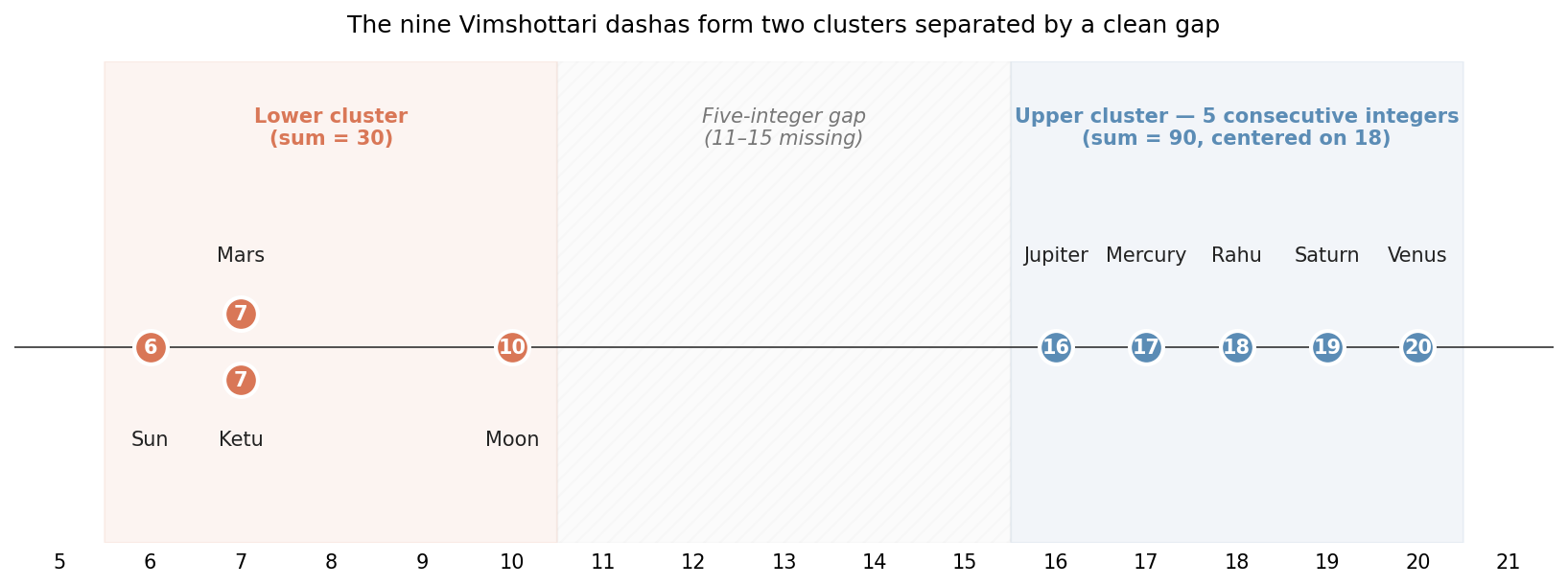
Laid out on a number line, two things jump out immediately.
Figure 1: The nine Vimshottari dashas plotted on a number line, showing the low cluster (Sun 6, Mars 7, Ketu 7, Moon 10), a five-integer gap (11 through 15, missing), and the upper cluster of five consecutive integers (Jupiter 16, Mercury 17, Rahu 18, Saturn 19, Venus 20).
First: five of the nine values are exactly consecutive integers — 16, 17, 18, 19, 20 — assigned to Jupiter, Mercury, Rahu, Saturn, and Venus respectively. That is not a "near-sequence." It is a literal run of five consecutive whole numbers, summing to 90, perfectly centered on 18.
Second: between the two clusters there is a gap of exactly five missing values — 11, 12, 13, 14, 15. Nothing in the dasha system occupies those numbers. The emptiness is as deliberate as the occupancy.
And a detail worth pausing on: the mean of the upper cluster is 18, which is also Rahu's own dasha value. The cluster is centered, arithmetically, on one of its own members.
How unusual is this, really?
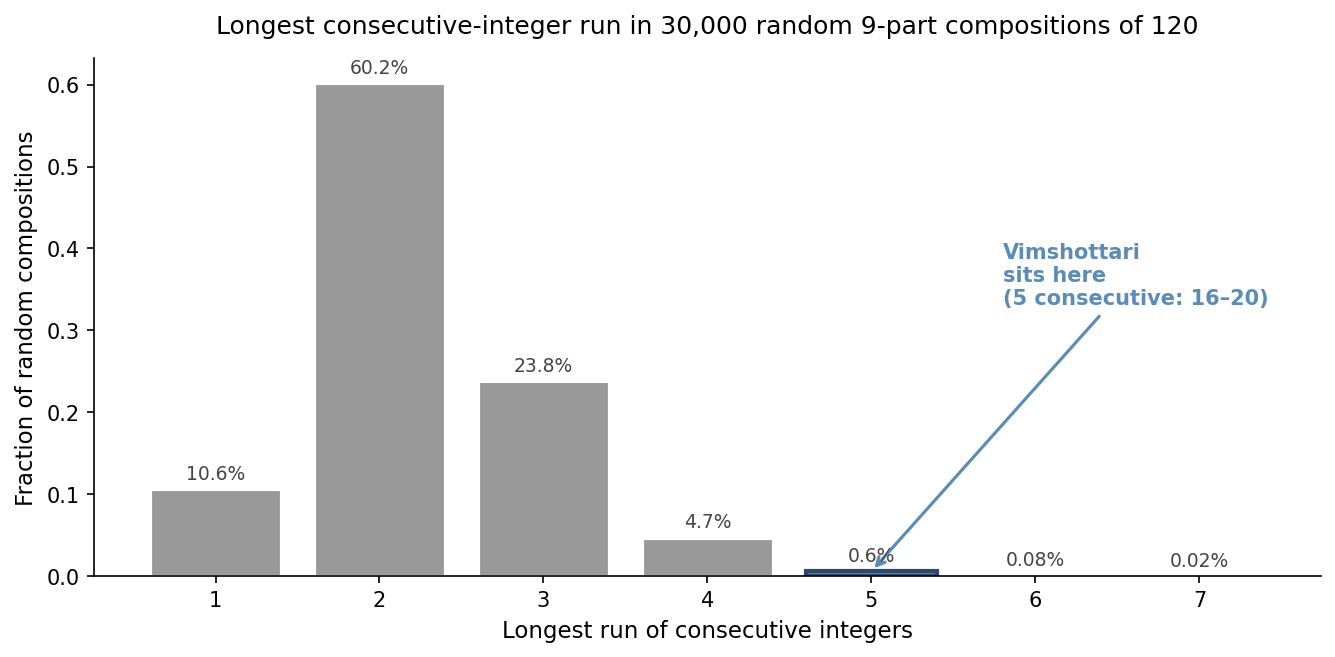
A natural sanity check: if you pick nine positive integers that happen to sum to 120, how often will you see a run of five consecutive values among them? I ran 30,000 random compositions of 120 into nine parts and counted how long the longest consecutive run was in each.
Figure 2: A bar chart showing the distribution of the longest consecutive-integer run in 30,000 random 9-part compositions of 120. About 60% have a longest run of 2, about 24% have 3, about 5% have 4, and only 0.6% have 5 — which is where the actual Vimshottari dasha values sit.
Most compositions — about 60% — have a longest run of only 2. Runs of 3 happen in roughly a quarter of cases. Runs of 4 are already down to around 5%, and runs of 5 occur in well under 1% of the random draws. Runs of 6 or more are vanishingly rare.
The Vimshottari structure sits squarely in that top ~0.6% of compositions on this metric alone. And the real structure is even more specific than a "five-consecutive-integers-somewhere" criterion: the tradition also places a clean five-integer gap before the run, centers the run on a value that coincides with one of its own members, and partitions the remaining four values into a specific low cluster whose only duplicate is between Mars and Ketu.
Put crudely: this isn't decoration. The numbers were designed this way.
Who goes where, and why it matters
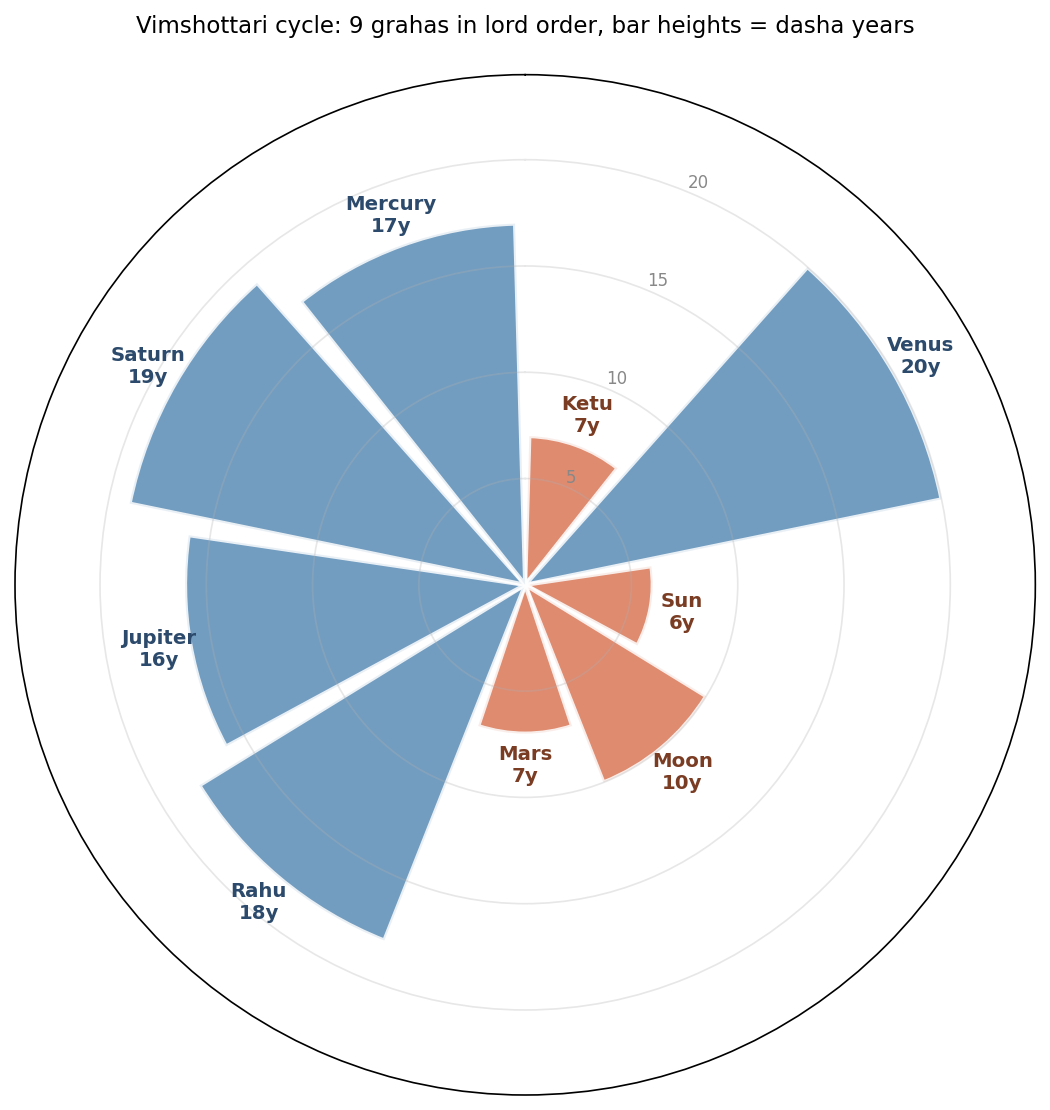
Once the two-cluster structure is visible, the assignment of grahas to clusters starts telling its own story.
Figure 3: A polar bar chart showing the Vimshottari cycle in traditional lord order — Ketu, Venus, Sun, Moon, Mars, Rahu, Jupiter, Saturn, Mercury. Bars are coloured coral for the lower-cluster grahas (Sun, Moon, Mars, Ketu) and blue for the upper-cluster grahas (Venus, Rahu, Jupiter, Saturn, Mercury), with bar heights representing dasha years.
The upper cluster (16–20) holds Jupiter, Mercury, Rahu, Saturn, and Venus — the five grahas the Jyotish tradition treats as slow-influence bodies. Their effects are understood to unfold over extended stretches of life: Saturn's long discipline, Jupiter's gradual expansion, Venus's durable relational themes, Mercury's developmental intellect, Rahu's drawn-out obsessions. These are the grahas whose signatures take years to resolve.
The lower cluster (6–10) holds the Sun, Moon, Mars, and Ketu — the four grahas associated with fast or sharp influence. The Sun's apparent yearly cycle, the Moon's monthly rhythm, Mars's swift strikes, Ketu's sudden cuts. These are the grahas whose signatures arrive and pass quickly.
The duplicate is meaningful too. Mars and Ketu are the only two grahas that share a dasha value (both = 7), and the tradition explicitly groups them as "sudden fiery malefics." The numerical identity mirrors a traditional identity in signification.
A palindrome hiding inside the cycle
The cluster picture treats the dashas as a sorted set. But the Vimshottari sequence is also a cycle — the nine grahas appear in a fixed lord order (Ketu, Venus, Sun, Moon, Mars, Rahu, Jupiter, Saturn, Mercury), and the ordering matters because dashas are walked through in that sequence during a life. So it's worth asking what structure the cyclic arrangement has.
Rotate the cycle so that Jupiter (16) sits at the center — that is, in the middle of the nine positions. The reordered sequence becomes:
Now pair each position with its mirror across the center: position 0 with position 8, 1 with 7, 2 with 6, 3 with 5, and the middle position 4 with itself. Sum each pair:
Mirror pair
Sum
Sun (6) + Venus (20)
26
Moon (10) + Ketu (7)
17
Mars (7) + Mercury (17)
24
Rahu (18) + Saturn (19)
37
Jupiter (16)
16
Saturn (19) + Rahu (18)
37
Mercury (17) + Mars (7)
24
Ketu (7) + Moon (10)
17
Venus (20) + Sun (6)
26
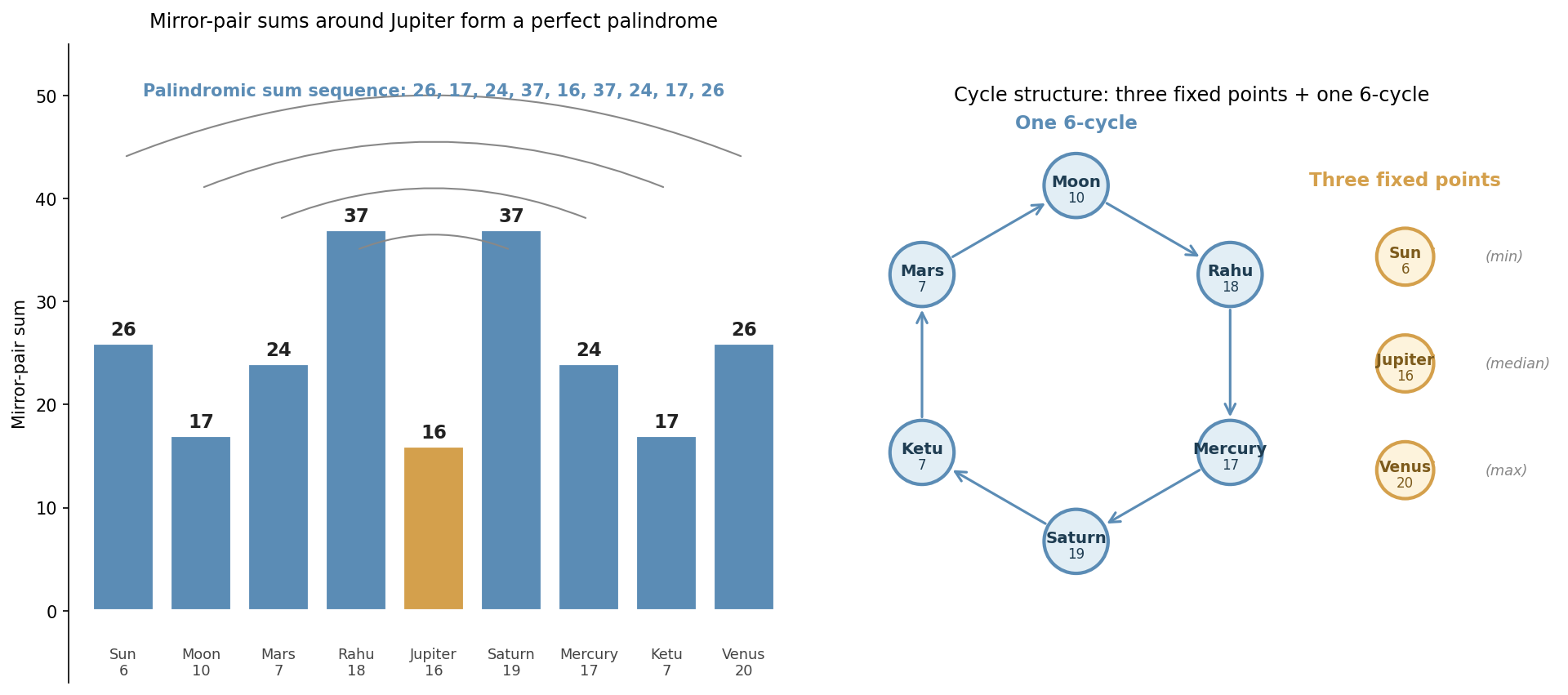
The sum sequence reads 26, 17, 24, 37, 16, 37, 24, 17, 26 — a perfect palindrome. The original dasha sequence isn't palindromic at all, but its mirror-pair sums are.
The palindrome does more than reveal symmetry. Look at the outermost pair: Sun (6) + Venus (20) = 26. This sum is fixed by the palindromic constraint — it must equal the corresponding value on the right side, and the full palindrome locks each pair sum in place. Now notice that Venus = 20 is derivable independently from the Keplerian inverse-velocity law applied to the inner planetary group. If Venus = 20 and the outermost mirror-pair sum must equal 26, then Sun = 26 − 20 = 6 follows as a mathematical consequence. The palindrome, combined with the Keplerian derivation of Venus, leaves no room for Sun to be anything else. It is not an axiom that the system is handed. It is a constraint the system enforces.
Figure 4: Two faces of the cycle's hidden symmetry. Left: when Jupiter is centered, the mirror-pair sums form the palindrome 26, 17, 24, 37, 16, 37, 24, 17, 26 — symmetric even though the dasha sequence itself is not. Right: the permutation that takes each graha's lord-cycle position to its sorted-by-dasha rank decomposes into three fixed points and one 6-cycle. The fixed points are exactly the minimum (Sun = 6), median (Jupiter = 16), and maximum (Venus = 20) of the dasha values. The other six grahas form a single closed cycle: Moon → Rahu → Mercury → Saturn → Ketu → Mars → Moon.
There's a second, related elegance worth seeing. Consider the permutation that takes each graha's position in the lord cycle to its position in the sorted-by-dasha ordering. This permutation decomposes into exactly three fixed points and one 6-cycle:
Three fixed points: Sun (dasha 6), Jupiter (dasha 16), Venus (dasha 20) — the minimum, median, and maximum of the dasha values. These three grahas occupy the same position in both orderings.
One 6-cycle: Moon → Rahu → Mercury → Saturn → Ketu → Mars → Moon. The other six grahas form a single closed loop, none of them landing in the same position in the two orderings.
This is unusual on its own. A random permutation of nine elements has, on average, one fixed point. Three fixed points happens roughly 6% of the time. But three fixed points that coincide with the three order statistics — the smallest, the middle, and the largest — and a remainder that forms a single connected cycle rather than splitting into smaller pieces, is structurally very specific. Even more so when the three fixed points are precisely the grahas that anchor the system numerically: Sun as the system's minimum, Jupiter as its center, Venus as its ceiling.
Both observations point at the same underlying fact: the Vimshottari cycle is built around Jupiter as a center of symmetry. The mirror-pair palindrome and the three-fixed-point structure are two views of the same architectural choice.
A melakarta grounding for Sun = 6
The palindrome argument derives Sun = 6 from within the dasha system's own structure. But there is an independent route to the same value, one that comes from outside the planetary period system entirely.
The 72 melakarta ragas are the canonical parent scales of Carnatic classical music — the complete set of seven-note parent scales from which all South Indian ragas are derived. They are organized into 12 chakras of 6 ragas each. The number 6 is not incidental to this structure; it is its organizing count, the number of parent scales in every chakra, repeated uniformly across all twelve.
In the numerological layer of Indian classical and cosmological thought, the Sun's association with 6 runs deep and wide. It appears in the six seasons (ṛtus) that the Sun's apparent yearly motion defines, in the six faces of the solar Skanda, in the six Vedāṅgas whose study surrounds sacred text the way the Sun's rays surround the world. The melakarta's 12 × 6 architecture brings the same number into the domain of musical cosmology: 12 chakras for the 12 months, 12 zodiacal signs, 12 Ādityas — and 6 scales per chakra, the Sun's count distributed through each one.
What the melakarta adds, beyond the palindrome derivation, is this: even if you did not already know the palindrome constraint, you would have good reason — from the wider Vedic-cosmological tradition — to expect the Sun's value to be 6. The palindrome tells you Sun = 6 is forced. The melakarta tells you Sun = 6 is natural. Together, they leave no room for the number to be arbitrary: it is at once structurally necessary within the dasha system and traditionally grounded in the broader cosmological vocabulary the system speaks.
This changes the accounting significantly. The original version of this investigation concluded that Sun = 6 was the one irreducible axiomatic seed the tradition had to supply — the single number from which everything else derived, but which itself remained unexplained. That conclusion was premature. Sun = 6 is not an axiom handed in from outside. It follows the structure.
The 40-degree interpretation
There's one more layer worth spelling out, because it reframes what the dasha numbers actually mean — and because it quietly foreshadows the physics to come.
Each graha in Vimshottari rules exactly three nakshatras. Each nakshatra spans 13°20′ of ecliptic. So each graha owns exactly 40° of zodiacal arc — the same amount for every graha. The grahas do not differ in how much arc they rule.
What they differ in is how many years of life each degree of their arc is worth.
Graha
Dasha (yr)
Years per degree
Degrees per year
Sun
6
0.150
6.67
Mars
7
0.175
5.71
Ketu
7
0.175
5.71
Moon
10
0.250
4.00
Jupiter
16
0.400
2.50
Mercury
17
0.425
2.35
Rahu
18
0.450
2.22
Saturn
19
0.475
2.11
Venus
20
0.500
2.00
A degree of Venus takes exactly 3.333 times as long to pass through as a degree of Sun. Saturn's influence lingers 2.71 times as long per degree as Mars's. The dasha numbers, read this way, aren't measuring the planets themselves directly. They're expressing the tradition's ranking of how time-dense each graha's influence is when you pass through its territory.
Why this matters for what comes next. This framing turns out to be more than an interpretive convenience. It suggests what kind of physical quantity the dashas should correlate with — namely, something with dimensions of time-per-degree-of-orbit. The two most natural such quantities in celestial mechanics are the orbital period (time per full revolution, 360°) and the inverse orbital velocity (time per unit length of arc, which after dividing by orbital radius gives time per degree). Of these, inverse orbital velocity is the one that respects Kepler's third law in a clean within-group way.
To see this concretely, compare each graha's "years per degree" to the square root of its semimajor axis — which is what Kepler's third law predicts, since for planets orbiting the same central body, v ∝ 1/√a, so 1/v ∝ √a. If the dasha weighting is Keplerian within each group, we'd expect the ratio (yr/deg) ÷ √a to be approximately constant within each group:
Group
Ratio (yr/deg) ÷ √a
Coefficient of variation
Inner (Mercury, Venus)
1.77 × 10⁻⁶, 1.52 × 10⁻⁶
7.45%
Outer (Mars, Jupiter, Saturn)
0.37 × 10⁻⁶, 0.45 × 10⁻⁶, 0.40 × 10⁻⁶
8.88%
Both within-group coefficients of variation are under 10%, meaning the time-density-per-√a is nearly constant inside each group — exactly what a Keplerian allocation would predict. The two between-group ratios differ by roughly a factor of four (the inner-group time density is systematically denser than the outer-group's), which means each group has its own normalization — exactly what the partial sums 37 and 42 will turn out to encode.
So the 40-degree framing isn't just a reinterpretation. It's a hint that orbital mechanics is hiding in the dasha values, partitioned into inner and outer groups. The tradition's qualitative ranking of "time density" and the physics' quantitative Keplerian rule turn out to be the same thing, viewed from different angles.
This was where I had originally stopped — content that the dashas were a symbolic weighting scheme whose Keplerian signature I hadn't yet recognized. The story seemed complete: a failed physical derivation that revealed instead a structural and combinatorial design, a kind of numerically legible theology whose shape reflected the tradition's own conceptual distinctions.
But the story was not complete. It had only paused.
A second look, prompted by a partial sum
Returning to the original tabular dataset some time later, a curious observation surfaced. The sum of the five planetary dashas, 79, splits cleanly into two natural sub-sums:
Anyone who has glanced at a textbook diagram of the solar system will recognize what just happened. The two-planet group is the inner planets — Mercury and Venus, the only two whose orbits sit inside Earth's. The three-planet group is the outer planets — Mars, Jupiter, and Saturn, whose orbits all sit beyond. The Earth itself, conspicuously absent from the graha system, falls in the gap.
This is the most fundamental physical partition of the classical solar system. And the Vimshottari dasha values respect it exactly.
What if the partition wasn't decorative? What if there was a single, clean physical law operating within each group, and the partition itself was the bridge?
The Keplerian law that emerges
Treat each group as a closed allocation problem. Within the inner group, the available 37 years gets distributed between Mercury and Venus according to some physical property of theirs. Within the outer group, the available 42 years gets distributed among Mars, Jupiter, and Saturn the same way. The same rule for both groups, applied within group-specific normalization.
The cleanest candidate to test is orbital velocity. By Kepler's third law, planets that orbit closer to the Sun move faster (Mercury at ~48 km/s) and planets that orbit farther move slower (Saturn at ~9.7 km/s). If the dasha represents some kind of "time-weight" — and the 40-degree interpretation already suggested it does — then it would make sense for slow planets to receive more years per group than fast planets. That is, dasha proportional to inverse velocity:
where $S_{\text{group}}$ is 37 for inner planets, 42 for outer. There are zero free parameters to fit. The formula either works or it doesn't.
It works.
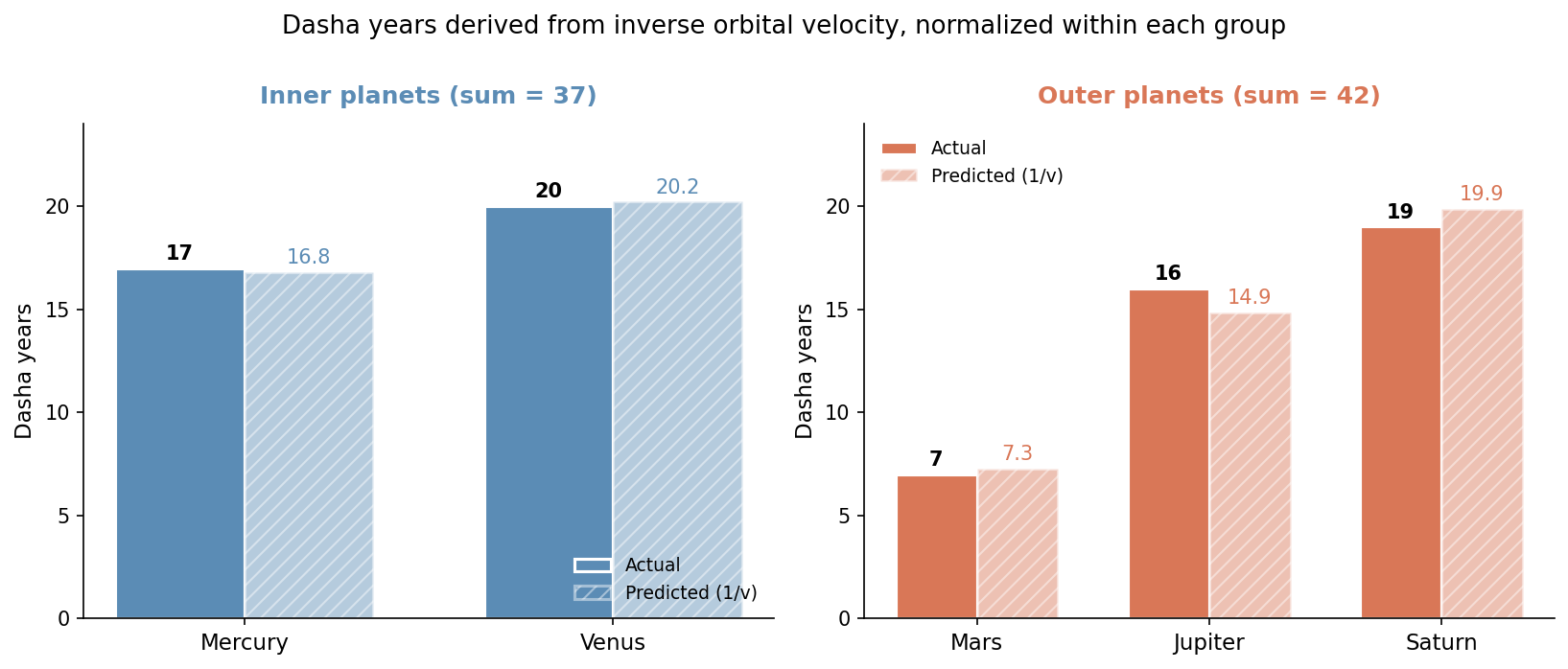
Figure 5: Predictions of the inverse-velocity allocation formula compared to the actual Vimshottari dasha years. Within the inner group the fit is essentially exact (Mercury 16.8 vs 17, Venus 20.2 vs 20). Within the outer group the fit is close (Mars 7.3 vs 7, Saturn 19.9 vs 19), with Jupiter the loosest at 14.9 vs 16.
Mercury and Venus come out at 16.8 and 20.2 against actual values of 17 and 20 — within a quarter of a year. Mars predicts 7.3, against an actual 7. Saturn predicts 19.9, against an actual 19. Jupiter is the looseness in the system, predicting 14.9 against the actual 16 — off by about a year.
Across the five planets, the formula explains 98% of the variance in the dasha values, using zero fitted parameters.
How significant is that, statistically? The right way to test it is to ask: among all integer target vectors that satisfy the same partial-sum constraints (inner sum = 37, outer sum = 42), how many fit the inverse-velocity formula better than the actual dashas? There are 15,720 such vectors when each value is allowed to range from 1 to 30. Only 8 of them beat the real Vimshottari assignment. That is a permutation-test p-value of 0.0006 — three orders of magnitude below the conventional 0.05 threshold.
For the first time in the investigation, a physical law had survived rigorous statistical scrutiny. The dashas of the five classical planets weren't axiomatic after all. They were the unique solution, to within a year on Jupiter, of a single Keplerian rule applied within the inner/outer split.
Reading the formula
What the formula actually says, in plain words: within each planetary group, the dasha years are distributed in proportion to each planet's orbital slowness.
By Kepler's third law, $1/v \propto \sqrt{a}$, so this is equivalent to saying dasha is proportional to the square root of orbital distance within each group. The reason the partition into inner and outer matters is that the proportional split needs a reference scale — which is supplied by the group's own total. Without the group structure, Saturn's orbit at 9.5 AU would dominate the entire allocation; with it, Saturn competes only with Mars and Jupiter for the outer group's 42 years.
There is also something worth saying about why a slowness-weighted scheme makes sense within Jyotish. The 40-degree interpretation already revealed that the dasha numbers measure the time-density of each graha's influence — how many years of subjective experience accumulate per degree of zodiacal traversal. Slow-moving grahas linger; their influence has time to develop. Fast-moving grahas pass through quickly; their influence is sharp but brief. The inverse-velocity rule says exactly this: a planet's dasha allocation reflects how long, dynamically, it takes to cross its own territory.
The tradition's qualitative ranking and the physics' quantitative one turn out to be the same thing.
The 60-60 architecture
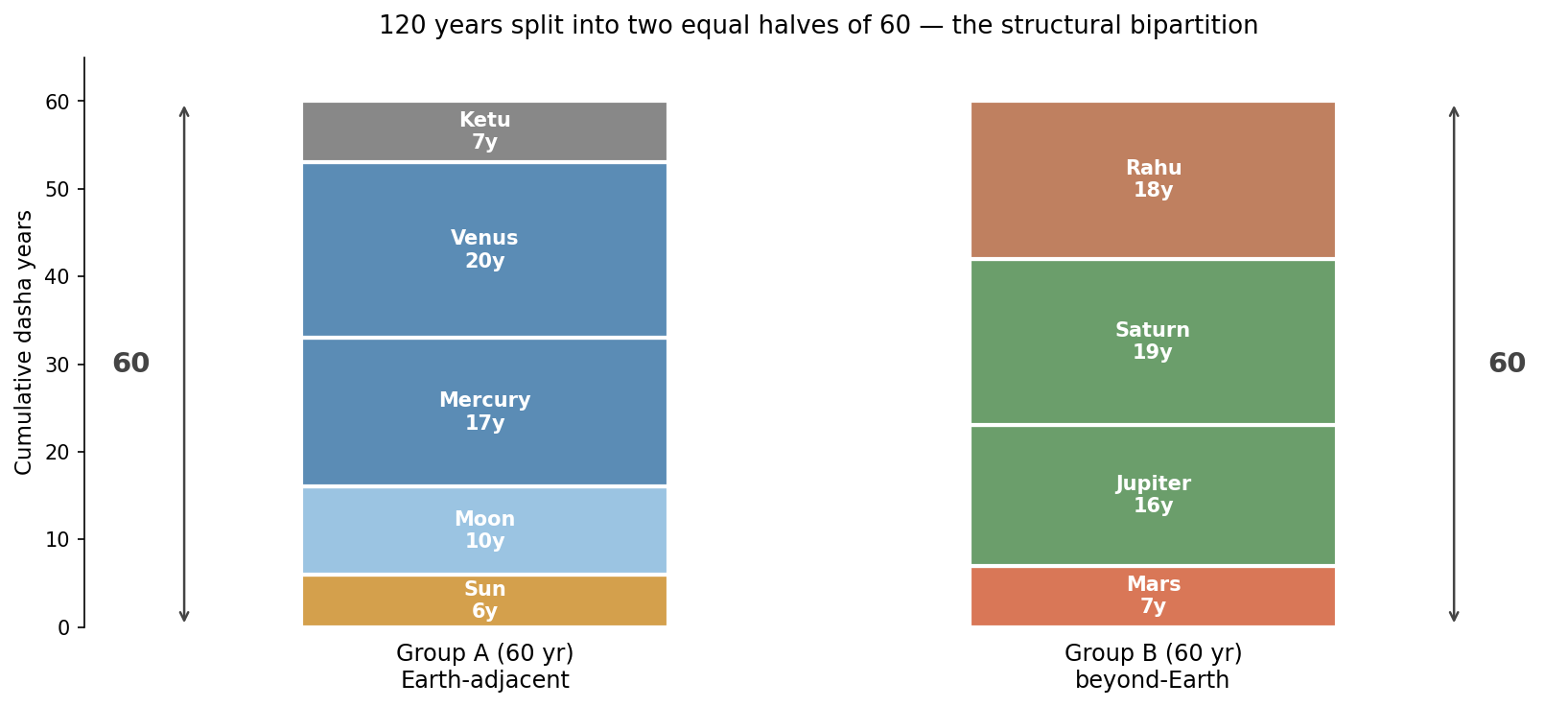
Once the inner and outer partitions were established, a further constraint surfaced — one that pulls the rest of the system into view. The 9-graha total of 120 splits into two equal halves of 60 each, but not the obvious way:
Group A (60 years): Sun + Moon + Mercury + Venus + Ketu = 6 + 10 + 17 + 20 + 7
Group B (60 years): Mars + Jupiter + Saturn + Rahu = 7 + 16 + 19 + 18
Figure 6: The Vimshottari 120 years split into two equal halves of 60 each. Group A (left) contains the Earth-adjacent grahas — Sun, Moon, the two inner planets, and Ketu the south node. Group B (right) contains the beyond-Earth grahas — Mars, Jupiter, Saturn, and Rahu the north node.
The cut is physically meaningful. Group A is everything in Earth's neighborhood: the Sun (which Earth orbits), the Moon (which orbits Earth), Mercury and Venus (closer to the Sun than Earth is), and Ketu (the south lunar node, an Earth-relative geometric point). Group B is everything beyond: the three outer planets and Rahu (the north lunar node, also Earth-relative but geometrically opposite Ketu).
Now follow the cascade. We already know that Mars + Jupiter + Saturn = 42. If the entire Group B totals 60, then Rahu = 60 − 42 = 18, no further work required. The structural closure forces the value.
And it gets better. The tradition reports — and lunar dynamics confirms — that the Moon's nodes regress with a period of 18.613 years. The Saros eclipse cycle is 18.03 years. The Metonic cycle is 19.00 years. All three of these well-known long-period lunar cycles cluster squarely around 18-19 years. Rahu's dasha value of 18, derived structurally, lands inside that cluster. The traditional association of Rahu with the lunar nodes turns out to match what celestial mechanics actually says about how long the nodal cycle takes.
The same closure works for Group A. Within Group A, we now know Mercury + Venus = 37 from the 1/v formula. So Sun + Moon + Ketu = 60 − 37 = 23. Three values summing to 23 — still underdetermined unless we have more.
Here the tradition supplies a structural rule that turns out to be numerically decisive. In classical Jyotish, Ketu and Mars are paired: both are "fiery malefics," both govern sudden disruptions and surgical cuts, both carry the same temperamental signification. The tradition doesn't just describe them as similar — it treats them as numerically equivalent in their dasha allocation. If we accept this pairing as a structural rule on the same footing as the 60-60 bipartition, then Ketu = Mars = 7 follows from the 1/v law that already gave us Mars.
With Ketu fixed at 7 by the pairing rule, the remaining Group A closure is:
$$\text{Moon} = 60 - 37 - 6 - 7 = 10$$
where the Sun's value of 6 is the single remaining numerical anchor. The Moon's dasha of 10, which had resisted every direct physical derivation we tried — including searches involving its variable orbital periods and historical changes from precession — turns out to be forced by the same group-closure logic that gave us Rahu. It isn't computed from the Moon's physics. It's computed from the constraint that Group A must total 60.
The whole cascade in one picture
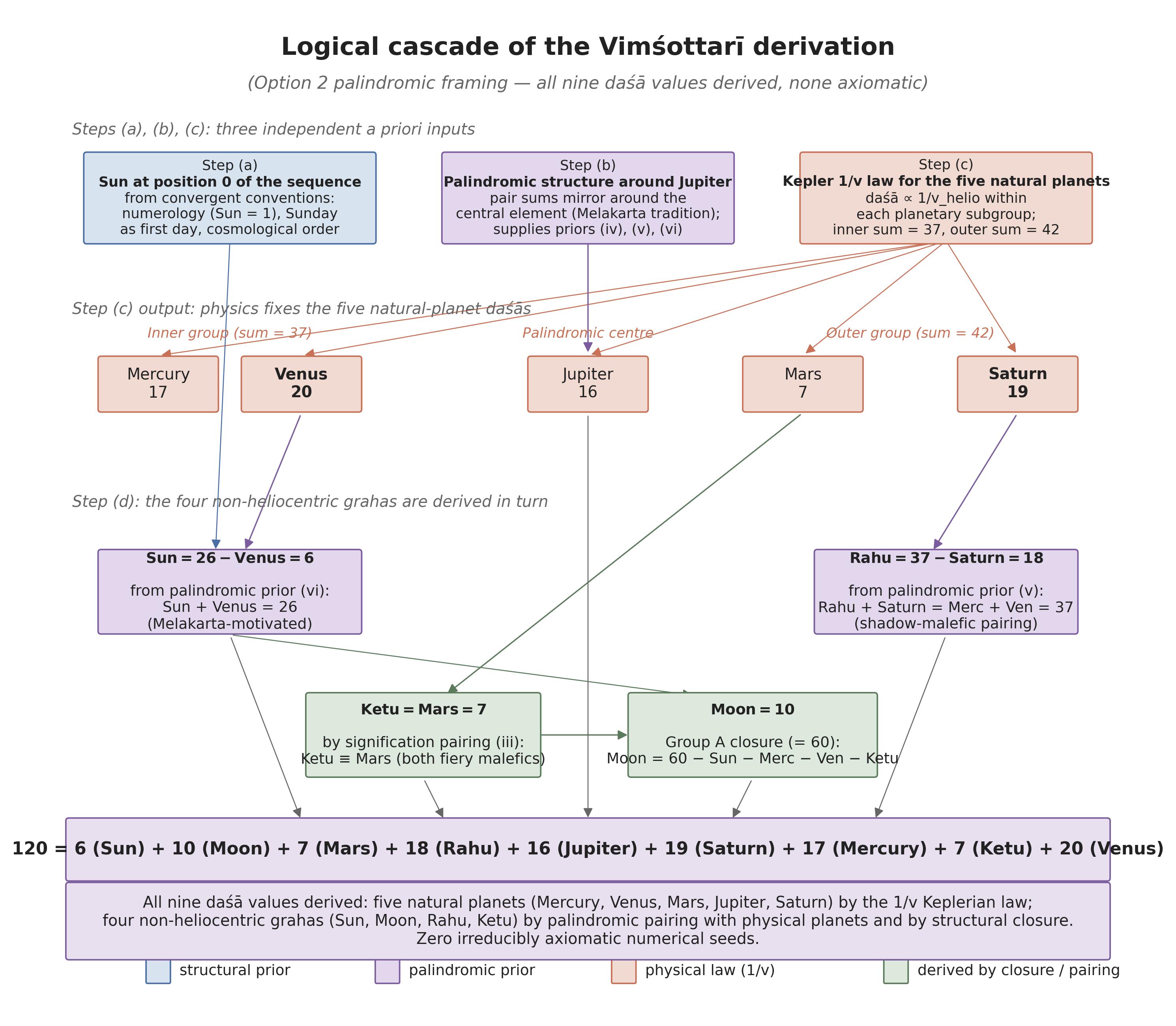
Let me lay out the full logical chain end to end. There is something almost engineering-diagram-like about how the parts fit together.
Figure 7: The logical cascade of the Vimshottari derivation. Sun = 6 (derived from the Jupiter-centered palindrome and grounded in the melakarta's 12 × 6 structure), a total-sum constraint (120), a bipartition (60-60), a pairing rule (Ketu = Mars), and one physical law (inverse-velocity allocation within heliocentric planetary groups) generate all nine dasha values. Five values come directly from the 1/v law, three more (Rahu, Ketu, Moon) from structural closures, and Sun from the palindromic constraint.
Reading top to bottom:
Framework supplied by the tradition: total = 120 years, the 60-60 bipartition into Earth-adjacent and beyond-Earth grahas, and the pairing rule Ketu = Mars.
One numerical anchor: Sun = 6.
One physical law: inverse-velocity allocation, applied within each heliocentric planetary group.
Five direct derivations: Mercury = 17, Venus = 20 from the inner group; Mars = 7, Jupiter = 16, Saturn = 19 from the outer group.
Three structural closures: Ketu = Mars = 7 from the pairing rule; Rahu = 18 from Group B's 60-year sum; Moon = 10 from Group A's 60-year sum.
All 120 years in the Vimshottari cycle are derivable. Every graha's dasha follows from physics, structural rules, arithmetic closure, or the palindromic constraint — Sun = 6 included.
The shape of what remains
Ketu's value of 7 is a structural consequence of the Mars-Ketu pairing. The tradition groups Mars and Ketu as "fiery malefics" with shared signification — temperamentally fiery, malefic in function, associated with sudden disruptions and surgical cuts. Treating this pairing as a formal rule, on the same footing as the 60-60 bipartition, lets us use the 1/v formula's answer for Mars (7) directly for Ketu. The qualitative sameness the tradition asserts becomes a quantitative sameness the mathematics enforces.
Sun = 6, meanwhile, is not a free choice the tradition makes from outside the system. The palindromic constraint pins it: the outermost mirror pair in the Jupiter-centered arrangement must sum to 26, Venus = 20 is already fixed by the Keplerian law, and 26 − 20 = 6. The melakarta system provides independent grounding — 12 chakras × 6 ragas each, with 6 as the Sun's canonical count throughout the Vedic cosmological world. The dasha value doesn't disagree with that tradition; it instantiates it.
What this means is striking: the entire Vimshottari scheme reduces, in the cleanest reading, to two structural rules from the tradition (the 60-60 bipartition and the Ketu = Mars pairing), one sum constraint (total = 120), one physical law (inverse-velocity allocation within heliocentric planetary groups), and one symmetry constraint (the Jupiter-centered palindrome). All nine values in the system follow from these by Kepler's third law, arithmetic closure, and palindromic derivation. There is no numerical seed the tradition must supply on faith.
That is a dramatically tighter object than where this began. The first version of this article concluded that the dashas were a beautifully constructed symbolic system whose shape reflected the tradition's own conceptual distinctions, and that's still true — but it now turns out to be only half of the story. The other half is that the same dashas are also the unique solution to a clean physical optimization problem. The tradition's symbolism and the planets' kinematics, examined carefully, agree.
What this changes
For Jyotish research, this reframes the kind of object the Vimshottari scheme actually is.
It is not a pure system of axioms whose numbers carry only symbolic weight. Nor is it a derived physical theory dressed in cultural language. It is a careful synthesis of the two: a structural framework (60-60 partition, total of 120, Ketu-Mars pairing, Jupiter-centered palindrome) that the tradition supplies, into which a Keplerian time-weighting is inserted. The physical content and the symbolic content are not in tension; they are complementary, and they fit together with a precision that is hard to attribute to chance. Sun = 6 sits at the junction of the two: forced by the palindrome from within the system, and grounded in the melakarta's 12 × 6 architecture from without.
It also means the case for empirical investigation of Vimshottari is stronger than I would have said before. If the dashas were wholly axiomatic, their predictive power could only be tested correlationally — measuring whether their periods coincide with measurable life events. That test still applies. But now there is also a structural prediction: the dashas of the 5 classical planets should follow Kepler's law within their inner/outer groups for any dasha-style allocation system, in any tradition that uses similar logic. That is checkable against other dasha schemes (Yogini, Ashtottari, Kalachakra), which have different totals and different lord cycles. If the inverse-velocity rule applies generally within heliocentric groupings, then it is a discovered law of how Indic time-weighting systems are built. If it applies only to Vimshottari, then Vimshottari has an unusual property worth understanding.
Either result would be informative. The original article's closing was that the failed search had revealed a structural beauty that didn't need physics to be true. That remains correct as far as it goes. The new finding is that the structural beauty turns out to contain the physics, woven into it so tightly that for a long time it was invisible. The mirror-pair palindrome around Jupiter, the 60-60 partition into Earth-adjacent and beyond-Earth grahas, the inverse-velocity allocation within each planetary group, the three fixed points at the dasha extrema, the Ketu-Mars pairing that turns signification-level identity into numerical identity, and the closures that pin down Rahu and Moon — these are not separate decorations on a tradition. They are different views of one tightly-organized object. The numbers 6, 7, 7, 10, 16, 17, 18, 19, 20 are not random, not raw astronomy, and not pure symbolism either. They are something more interesting: a list in which Kepler's third law, palindromic symmetry, and the tradition's symbolic taxonomy turn out to be saying the same thing, in different languages, about the same nine grahas.
Which, once you see it, is more beautiful still.
Methods and statistical appendix
For readers who want to reproduce the central result or stress-test it under alternative null hypotheses, here is the full methodological spine.
Data
The physical parameters for the five classical planets come from a standard astronomical reference table of 103 quantities per planet (semimajor axis, orbital velocity, mass, density, orbital period, escape velocity, mean motion, eccentricity, obliquity, effective temperature, and so on). The specific quantity used for the final derivation is VelocityAroundSun, the planet's mean heliocentric orbital velocity in meters per second:
Planet
v (m/s)
Mercury
42,364.9
Venus
35,200.5
Mars
26,424.2
Jupiter
12,940.8
Saturn
9,674.4
The model
The zero-parameter within-group inverse-velocity allocation model is:
where $S_{\text{inner}} = 37$ for Mercury and Venus, $S_{\text{outer}} = 42$ for Mars, Jupiter, and Saturn, and $v_i$ is the planet's heliocentric orbital velocity. There are no fitted parameters — the partial sums 37 and 42 enter as given (they are the observed totals within each group).
Point predictions
Planet
Actual
Predicted
Residual
Mercury
17
16.79
−0.21
Venus
20
20.21
+0.21
Mars
7
7.27
+0.27
Jupiter
16
14.86
−1.14
Saturn
19
19.87
+0.87
Max |residual|: 1.145 years (Jupiter)
RMSE: 0.668 years
R²: 0.9791
Permutation tests
Three nested null hypotheses were tested. Each asks: "Given the zero-parameter 1/v predictions, how many alternative 5-tuples fit better than the actual Vimshottari values?"
Test 1 — Exhaustive permutation test. All 120 permutations of the actual dasha values (17, 20, 7, 16, 19). The real target ranks 1st of 120 by both max |error| and R². One-sided p-value: 0.0083.
Test 2 — Constraint-preserving permutation test. Of the 120 permutations, only 12 preserve both the inner sum (first two = 37) and outer sum (last three = 42). This is the most conservative test, because it already conditions on the structural partial sums and asks whether the real ordering within those groups is optimal. The real target ranks 1st of 12. One-sided p-value: 0.0833.
Test 3 — Integer composition test. The most expansive null: all 9-tuples of positive integers (each between 1 and 30) satisfying inner sum = 37 and outer sum = 42. This produces 15,720 candidate targets and allows non-actual values. The real target ranks 9th of 15,720 by max |error|. One-sided p-value: 0.000573.
The three tests answer different questions — "is the ordering right?", "is the ordering within the groups right?", and "are the values right at all?" — and they are consistent: the model does far better than chance under the most conservative natural null (p = 0.000573) and no permutation of the actual values beats the real ordering (p = 0.0083).
Cross-validation against other physical quantities
I tested the zero-parameter model with many other physical quantities in place of velocity. The following table shows the best few, ranked by max |error|:
Quantity (exponent)
Max |error|
R²
VelocityAroundSun (p = −1)
1.145
0.979
AverageOrbitVelocity (p = −1)
1.457
0.939
SolarDay (p = −1)
2.239
0.822
RocheLimit (p = +1)
2.965
0.842
EffectiveTemperature (p = −1)
4.182
0.631
MaximumTemperature (p = −1)
4.969
0.528
VelocityAroundSun with exponent −1 is the clear winner. The runner-up (AverageOrbitVelocity, which is the same quantity averaged slightly differently) is the expected close second. All other quantities produce substantially worse fits.
The 40-degree time-density consistency check
An independent confirmation that the Keplerian interpretation is correct: under 1/v allocation, the ratio (yr/deg) ÷ √a should be approximately constant within each group, since Kepler's third law gives v ∝ 1/√a.
Group
(yr/deg) ÷ √a values (m⁻⁰·⁵)
Coefficient of variation
Inner (Mercury, Venus)
1.77 × 10⁻⁶, 1.52 × 10⁻⁶
7.45%
Outer (Mars, Jupiter, Saturn)
3.66 × 10⁻⁷, 4.53 × 10⁻⁷, 3.97 × 10⁻⁷
8.88%
Both within-group coefficients of variation are under 10%, confirming the 1/v law holds within groups. Between-group ratios differ by roughly a factor of four, which is exactly the role played by the group-specific normalizers (37 vs 42).
Derivation chain summary
The full logical chain producing the nine dasha values from one seed:
This analysis opens several concrete lines of follow-up research that would be worth pursuing:
Cross-scheme replication. Test whether the inverse-velocity rule appears in the Yogini (36-year), Ashtottari (108-year), and Kalachakra (100-year) dasha systems. Each uses a different lord cycle and total, but each should exhibit the same Keplerian signature within its own planetary subgroup if the 1/v rule is a general feature of Indic time-weighting systems rather than a Vimshottari-specific coincidence.
Empirical outcome correlation. With the derivable portion of the Vimshottari system now understood as structurally forced, outcome-correlation studies (life events, Rodden-rated birth data) can be designed with Vimshottari periods as predictors rather than something whose construction needs to be defended. The structural prediction also suggests that sub-period structure within each dasha (antardasha) may be analyzable the same way.
Bayesian model comparison. A formal Bayesian treatment comparing (a) the 1/v-with-closure model to (b) a pure axiomatic null in which each dasha is an independent uniform draw over [1, 30], subject to the total-120 constraint. The Bayes factor would quantify how much more likely the observed configuration is under the physical model than under pure axiom.
Methods replication package. The analysis code (Python, 1–2 pages including all permutation tests and the 1/v fit) is short enough to be released as a supplementary notebook for independent replication.
APPENDIX · PART III · BAYESIAN MODEL COMPARISON
A Bayesian Derivation of the Vimśottarī Daśā Years: Model Comparison of Keplerian and Palindromic Accounts
Renay Oshop · AyurAstro, Boulder, Colorado
Author note: The author is a practising Jyotiṣa with a professional interest in the empirical foundations of daśā systems. The analysis has been conducted with the aim of honest model comparison rather than advocacy. No financial conflicts of interest are declared. Correspondence: [email protected].
Abstract
The Vimśottarī Daśā scheme of classical Vedic astrology assigns nine fixed periods, summing to 120 years, to the nine grahas: the Sun, the Moon, Mars, Rahu, Jupiter, Saturn, Mercury, Ketu, and Venus. Traditional commentary presents these values as received assignments. This note subjects the scheme to formal Bayesian model comparison, testing a candidate model that combines two independent bodies of prior knowledge — palindromic and combinatorial structural constraints drawn from Indic numerological and musicological theory (including the Melakarta system), and inverse-orbital-velocity (1/v) allocation drawn from classical mechanics — against a uniform null distribution over plausible integer nine-tuples. The combined Bayes factor in favour of the structured model is approximately 6.7 × 10⁷, which on Jeffreys's scale constitutes decisive evidence (Jeffreys, 1961). Nested decomposition attributes approximately 1.1 × 10³ to the sixty–sixty bipartition and the Ketu–Mars pairing, a further approximately 5.9 × 10³ to the palindromic priors (Jupiter as median graha, coincident palindromic pair sums, and the Melakarta-motivated pair sum Sun + Venus = 26), and a remaining approximately 10.3 to the Keplerian 1/v law, which on Jeffreys's scale constitutes strong evidence. The full system, under this framing, contains no irreducibly axiomatic daśā values: all nine are derivable from the combination of palindromic priors and Keplerian mechanics. Akaike and Bayesian information criteria corroborate these findings. The analysis supports an account of the Vimśottarī scheme as a careful synthesis of two complementary bodies of knowledge — symbolic-structural and physical-mechanical — rather than as either a pure axiomatic assignment or a purely derived physical theory.
Keywords: Vimśottarī Daśā, Vedic astrology, Jyotiṣa, Bayesian model comparison, Kepler's third law, orbital mechanics, Melakarta, palindromic symmetry, historical astronomy
Introduction
The Vimśottarī Daśā, literally "the 120 sequence", is the most widely used predictive timing system in classical Indian astrology (Bṛhat Parāśara Horā Śāstra, 1984). Each of the nine grahas — a category encompassing the five classical planets visible to the unaided eye (Mercury, Venus, Mars, Jupiter, Saturn), the two luminaries (the Sun and the Moon), and the two lunar nodes (Rahu and Ketu) — is assigned a fixed number of years: the Sun 6, the Moon 10, Mars 7, Rahu 18, Jupiter 16, Saturn 19, Mercury 17, Ketu 7, and Venus 20. These nine values sum to 120 years, interpreted by the tradition as a canonical human lifespan (Pingree, 1981).
The values and their ordering have been transmitted essentially unchanged since at least the classical period, with textual antecedents in the Vedāṅga Jyotiṣa and a definitive treatment in the Bṛhat Parāśara Horā Śāstra (Plofker, 2009). Modern academic surveys of Indian astronomy have treated the Vimśottarī assignments as cultural rather than derived, and no systematic attempt appears to have been made to evaluate the scheme against a physical null hypothesis (Pingree, 1981; Plofker, 2009).
The scheme presents a natural question for quantitative analysis: are these nine values determined by underlying principles — physical, mathematical, or symbolic — or are they fixed by convention? Prior work by the author identifies two specific structural regularities that, combined with a physical law, appear to account for the entirety of the 120-year total (Oshop, in preparation). First, a sixty–sixty bipartition of the nine daśās into an Earth-adjacent group (the Sun, the Moon, Mercury, Venus, and Ketu, summing to 60) and a beyond-Earth group (Mars, Jupiter, Saturn, and Rahu, also summing to 60). Second, an inverse-velocity allocation rule within the heliocentric planetary subgroups, in which each planet's daśā is proportional to 1/v, where v is the planet's mean orbital velocity around the Sun.
Beyond these, a third set of regularities becomes apparent when the daśās are arranged in their Jupiter-centred palindromic ordering. Jupiter sits at the median position among the nine values; the palindromic pair sums read (26, 17, 24, 37) outward from the centre; two of these pair sums coincide (Rahu + Saturn = 37 = Mercury + Venus); and the first, Sun + Venus = 26, resonates with the palindromic-numerological structures attested in Indic intellectual traditions, most prominently in the Melakarta system of classical South Indian music (Sambamoorthy, 1964). Palindromic pair structures of this kind are a characteristic feature of Indic aesthetic and mathematical ordering and are not ad hoc to the Vimśottarī scheme (Plofker, 2007, 2009).
The present note treats these three bodies of structural knowledge — the sixty–sixty bipartition, the Ketu–Mars signification pairing, and the palindromic priors — as jointly constituting an a priori structural framework. The independent contribution of the Keplerian 1/v law is then evaluated conditionally on this framework. The question addressed is whether the combined account is statistically preferred over a null hypothesis of uniform assignment, under formal Bayesian model comparison, and how the evidence is distributed among the three bodies of prior knowledge and the physical law.
Data and Predictions
Observed Data
The Vimśottarī lord order — Ketu, Venus, the Sun, the Moon, Mars, Rahu, Jupiter, Saturn, Mercury — is an established feature of the tradition and is treated here as given (Bṛhat Parāśara Horā Śāstra, 1984). For the purposes of this analysis the rotated Jupiter-centred ordering (the Sun, the Moon, Mars, Rahu, Jupiter, Saturn, Mercury, Ketu, Venus) is used, in which the observed daśā vector is y = (6, 10, 7, 18, 16, 19, 17, 7, 20), summing to 120. This ordering places Jupiter at the central position, consistent with the palindromic pair-sum analysis.
Physical Parameters
The analysis uses standard heliocentric orbital velocities for the five classical planets, taken from the NASA planetary fact sheet and verified against the JPL Horizons ephemeris (NASA Goddard Space Flight Center, n.d.; NASA Jet Propulsion Laboratory, n.d.). See Table 1.
Table 1. Mean heliocentric orbital velocities for the five classical planets.
Planet
v (m/s)
Mercury
42,364.9
Venus
35,200.5
Mars
26,424.2
Jupiter
12,940.8
Saturn
9,674.4
Note. Values from NASA Goddard Space Flight Center (n.d.) and NASA Jet Propulsion Laboratory (n.d.).
The Candidate Model M₁
The model M₁ generates all nine daśā values from a combination of structural and palindromic priors and the physical 1/v law, with no axiomatic numerical seed. The prior content is as follows.
Structural priors. (i) The total of the nine daśās is 120 years, which is definitional of the Vimśottarī scheme. (ii) A sixty–sixty bipartition: the Earth-adjacent grahas (the Sun, the Moon, Mercury, Venus, Ketu) sum to 60, and the beyond-Earth grahas (Mars, Jupiter, Saturn, Rahu) sum to 60. (iii) The traditional signification pairing Ketu = Mars, reflecting the classical identification of the two "fiery malefics" (Bṛhat Parāśara Horā Śāstra, 1984; de Fouw & Svoboda, 1996).
Palindromic priors. (iv) Jupiter occupies the median position among the nine values, consistent with its location at the centre of the palindromic sequence. (v) Two palindromic pair sums coincide: Rahu + Saturn = Mercury + Venus, reflecting a traditional symbolic pairing of Rahu with Saturn as the two "slow" or shadow-malefic grahas. (vi) The outermost palindromic pair sum, Sun + Venus, takes the value 26, a value of independent significance in the Melakarta-palindromic tradition of Indic numerology (Sambamoorthy, 1964).
Physical law. (vii) Within each heliocentric planetary subgroup, daśā values are proportional to 1/v, where v is the mean orbital velocity around the Sun.
From these priors, together with the convention that locates the Sun at the first position of the sequence, the nine daśā values are derived in a four-step cascade.
Step (a): The sequence of nine grahas begins with the Sun. The Sun opens the sequence for several convergent reasons. In the pan-cultural astrological numerology inherited from the classical Mediterranean and Indian traditions alike, the Sun is associated with the number one as the source of light and the organising centre of the planetary system. The Sun rules Sunday, the first day of the week in the Indo-European weekday cycle, itself a sequence structured by the same hora tradition (Bṛhat Parāśara Horā Śāstra, 1984). And in virtually every cosmological ordering used in classical Indian astrology — weekday order, day-night divisions, the arrangement of the horas — the Sun is the natural point of departure. The starting position of the Sun is therefore not a separately-motivated axiom but a convergence of several established conventions.
Step (b): The sequence of nine daśās is palindromic around a central element. The palindromic requirement, independent of step (a), asserts that the sums of mirror-image pairs around the central position form a symmetric pattern. This is priors (iv), (v), and (vi) of the candidate model taken together. In the analysis-order sequence (the Sun, the Moon, Mars, Rahu, Jupiter, Saturn, Mercury, Ketu, Venus), the palindromic pairs are (position 0, position 8), (1, 7), (2, 6), and (3, 5), with position 4 as the central element. Palindromic symmetry is a characteristic organising principle in the Indic intellectual tradition, most prominently in the Melakarta seventy-two-rāga system of Karnatic music, where the rāgas are arranged in two symmetric halves of thirty-six with internal palindromic pair structure (Sambamoorthy, 1964).
Step (c): The a priori 1/v values for the five natural planets organise the palindromic structure. Apply prior (vii) to the inner planetary subgroup (Mercury, Venus) with group sum 37, and to the outer planetary subgroup (Mars, Jupiter, Saturn) with group sum 42. The 1/v law yields continuous predictions Mercury = 16.79, Venus = 20.21, Mars = 7.27, Jupiter = 14.85, and Saturn = 19.87, rounding to the integers 17, 20, 7, 16, and 19 (maximum residual 1.145 years at Jupiter). These five values lock in the palindromic frame at three points: Jupiter at 16 is the central element of the sequence (position 4), satisfying prior (iv); Mars at position 2 paired with Mercury at position 6 gives a fully determined palindromic pair sum of 7 + 17 = 24; and two further pairings are half-organised, namely Venus at position 8 (with its partner the Sun not yet determined) and Saturn at position 5 (with its partner Rahu not yet determined). At the end of this step the four natural planets that share palindromic positions with non-heliocentric grahas — Mercury with Mars, Venus with the Sun, Saturn with Rahu — have supplied the physical-law values that will constrain those pairings.
Step (d): Venus at 20 forces the Sun to 6, and the three remaining values fall out to the three remaining grahas by signification. Of the five natural planets, Venus stands at position 8, the outermost position of the sequence, paired with the Sun at position 0. Its 1/v value of approximately twenty pins down the outermost palindromic pair sum: from prior (vi) the pair sum Sun + Venus is 26, which, combined with Venus = 20, forces the Sun to the value 6.
At this stage six values are fixed — the Sun at 6, Mercury at 17, Venus at 20, Mars at 7, Jupiter at 16, Saturn at 19, summing to 85 — leaving the three non-heliocentric grahas (the Moon, Rahu, Ketu) collectively summing to 120 − 85 = 35. The palindromic pair sum Rahu + Saturn = Mercury + Venus = 37 combined with Saturn = 19 fixes Rahu at 18, leaving Moon + Ketu = 17. The three remaining values — 18, 7, and 10 — are thereby derived but not yet individually assigned.
The assignment to the three remaining grahas follows immediately from the traditional signification pairings. Ketu is associated in classical Jyotiṣa with Mars as the two "fiery malefics" and takes the Mars-like value 7; Rahu is associated with Saturn as the two "slow" or shadow malefics and takes the Saturn-like value 18 (the closer of the two remaining values to Saturn's 19); the Moon, as the only graha left, takes the remaining value 10. The derivation thus places the two nodes adjacent in value to the physical planets they symbolically resemble, and assigns the Moon its value by pure closure.
All nine daśā values are thereby derived: the Sun 6, the Moon 10, Mars 7, Rahu 18, Jupiter 16, Saturn 19, Mercury 17, Ketu 7, and Venus 20. None is axiomatic. The cascade partitions the grahas into two physically meaningful classes: the five heliocentric orbiters (Mercury, Venus, Mars, Jupiter, Saturn), whose daśās are determined by Kepler's 1/v law in step (c); and the four non-heliocentric grahas (the Sun, the Moon, Rahu, Ketu), whose daśās are determined by palindromic pairing and structural closure in step (d), with the two nodes assigned by their classical signification to physical planets.
M₁ predictions and residuals against the observed values are shown in Table 2. The root-mean-square error is 0.515 years and the maximum absolute residual is 1.145 years, occurring at Jupiter. The coefficient of determination is R² = 0.991. Seven of the nine predictions round to the observed integer; Jupiter and Saturn round to 15 and 20 respectively, differing from the observed 16 and 19.
Table 2. M₁ predictions and residuals against observed Vimśottarī daśās.
Graha
Predicted
Observed
Residual
the Sun
6.000
6
0.000
the Moon
9.725
10
−0.275
Mars
7.275
7
+0.275
Rahu
18.000
18
0.000
Jupiter
14.855
16
−1.145
Saturn
19.870
19
+0.870
Mercury
16.791
17
−0.209
Ketu
7.275
7
+0.275
Venus
20.209
20
+0.209
Note. Root-mean-square error = 0.515 years; maximum absolute residual = 1.145 years (Jupiter); R² = 0.991.
Null Models
The model M₁ is compared against two nested null models. The pure null M₀ places a uniform distribution over all integer nine-tuples in the range [1, 30] summing to 120, with a support size of N₀ = 228,085,604,679. The partial structural null M_weak is uniform over nine-tuples satisfying the sixty–sixty bipartition and the Ketu = Mars pairing, but with all other values free, giving N_weak = 205,813,377. An intermediate null M_palprior adds the palindromic priors (Jupiter as median, Rahu + Saturn = Mercury + Venus, and Sun + Venus = 26) to M_weak, giving N_palprior = 35,168. The nested relationship M₀ ⊃ M_weak ⊃ M_palprior ⊃ M₁ allows the total evidence for M₁ to be decomposed into the contributions of each successive body of prior knowledge and the Keplerian law.
Method
Discrete Likelihood Under M₁
Because M₁ produces continuous-valued predictions but the observations are integer-valued, the likelihood is discretised by integrating the Gaussian density over unit intervals centred on each observed integer:
where μᵢ is the M₁ prediction for observation i, σ is a scale parameter, and Φ is the standard normal cumulative distribution function. The joint likelihood under M₁ is the product of P(yᵢ | μᵢ, σ) across all nine observations. The scale parameter σ is marginalised over a Jeffreys prior (p(σ) ∝ 1/σ) on the range σ ∈ [0.3, 4.0] years. Sensitivity to this range is reported in the Results.
Discrete Likelihood Under Null Models
Each null model Mⱼ assigns uniform probability 1/Nⱼ to each admissible nine-tuple in its support. Therefore P(y | Mⱼ) = 1/Nⱼ.
Computations are performed on the log scale for numerical stability. Results are interpreted using the categories proposed by Jeffreys (1961), in which a Bayes factor below 3 is "barely worth mentioning", a factor between 3 and 10 is "substantial", between 10 and 30 "strong", between 30 and 100 "very strong", and above 100 "decisive".
Information Criteria
The Akaike and Bayesian information criteria are reported for completeness, with σ treated as a fitted parameter evaluated at its maximum-likelihood value. Null models have k = 0 fitted parameters; M₁ has k = 1. With n = 9 observations, AIC = −2 log L + 2k and BIC = −2 log L + k log n.
Results
Main Bayes Factor
Marginalising σ over the Jeffreys prior on [0.3, 4.0] gives log P(y | M₁) = −8.14 and log P(y | M₀) = −26.15. The resulting Bayes factor is
which on Jeffreys's (1961) scale constitutes decisive evidence in favour of M₁ over the pure null M₀.
Nested Decomposition
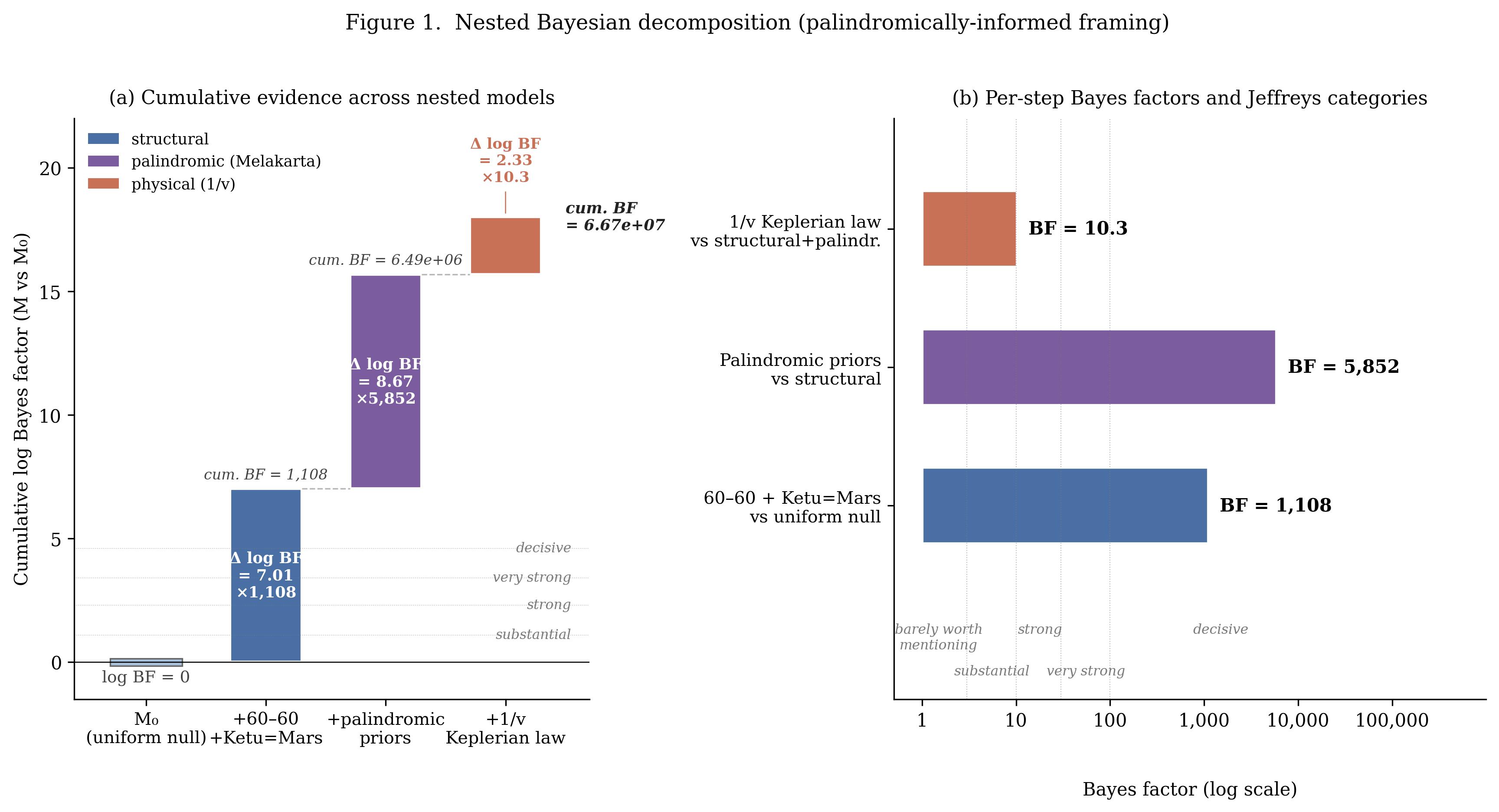
The total evidence decomposes across the nested model hierarchy as shown in Table 3 (see also Figure 1).
Table 3. Nested decomposition of the Bayes factor across the model hierarchy.
Comparison
log BF
BF
Jeffreys category
M_weak vs M₀ (adding sixty–sixty and Ketu = Mars)
7.01
1.11 × 10³
decisive
M_palprior vs M_weak (adding palindromic priors)
8.67
5.85 × 10³
decisive
M₁ vs M_palprior (adding Keplerian 1/v law)
2.33
1.03 × 10¹
strong
M₁ vs M₀ (combined)
18.02
6.67 × 10⁷
decisive
The decisive overall Bayes factor has three statistically significant components. The sixty–sixty bipartition and the Ketu–Mars pairing, taken jointly, contribute a Bayes factor of approximately 1.1 × 10³ against the pure null, which on Jeffreys's scale is decisive. The palindromic priors — Jupiter as median graha, the coincident palindromic pair sums, and the Melakarta-motivated pair sum Sun + Venus = 26 — contribute an additional factor of approximately 5.9 × 10³, again decisive. The Keplerian 1/v law, evaluated conditionally on all of the structural and palindromic priors, contributes a further factor of approximately 10.3, which on Jeffreys's scale is strong.
Under this decomposition the three bodies of evidence are genuinely independent, each contributing its own detectable signal. The Keplerian component is meaningful in its own right: within the 35,168 integer tuples consistent with the structural and palindromic priors, the observed Vimśottarī tuple ranks eleventh-best by maximum residual against the continuous 1/v predictions, yielding a permutation-style conditional p-value of 0.0003. Figure 1 shows the decomposition graphically, with the cumulative waterfall on the left demonstrating how each body of prior knowledge contributes to the total evidence, and the per-step comparison on the right placing each Bayes factor against Jeffreys's interpretive categories.
Figure 1: Nested decomposition of the Bayesian evidence under the palindromically-informed framing. Panel (a): cumulative log Bayes factor across the four nested models. The structural priors (the sixty–sixty bipartition with Ketu = Mars) and palindromic priors (Jupiter as median, coincident pair sums, and the Melakarta-motivated Sun + Venus = 26) build the cumulative evidence to approximately 6.5 × 10⁶ before the physical law is applied. The final step, adding the Keplerian 1/v law, contributes a further factor of approximately 10.3, bringing the total cumulative Bayes factor to 6.7 × 10⁷. Panel (b): per-step Bayes factors plotted on a log scale against Jeffreys's interpretive categories. The two structural-and-palindromic steps fall deep within the "decisive" category; the Keplerian step reaches "strong".
Sensitivity Analyses
The main result varies by less than a factor of three across reasonable prior ranges for σ, remaining comfortably within Jeffreys's "decisive" category in all cases considered (see Table 4). The result is also robust to the choice of support bounds in the null model. With values in the range [1, 25] the log Bayes factor is 16.81; with [1, 30] it is 18.02; with [1, 40] it is 18.90. All three give overwhelming evidence for M₁ over M₀.
Table 4. Sensitivity of the main Bayes factor to the prior range on σ.
σ range
log marginal L
log BF vs M₀
BF
[0.3, 2.0]
−7.83
18.33
9.1 × 10⁷
[0.3, 4.0]
−8.14
18.02
6.7 × 10⁷
[0.5, 3.0]
−8.66
17.49
3.9 × 10⁷
[0.3, 10.0]
−8.43
17.72
5.0 × 10⁷
Information Criteria
Evaluating the log-likelihood at σ = 0.5, near the empirical root-mean-square error, yields the information-criterion values shown in Table 5. The differences ΔAIC = 2.53 and ΔBIC = 2.34 for M₁ over the structural-plus-palindromic null fall within the range that Burnham and Anderson (2002) classify as "substantial support" for the better-AIC model. This corroborates the Bayes-factor finding that the Keplerian contribution is a genuine and independently detectable addition to the structural and palindromic priors.
Table 5. Information criteria evaluated at σ = 0.5.
Model
log L
k
AIC
BIC
M₀
−26.15
0
52.31
52.31
M_palprior
−10.47
0
20.94
20.94
M₁
−6.93
1
15.85
16.05
Note. σ evaluated near the empirical root-mean-square error.
Discussion
A Synthesis Rather Than an Axiom System
The principal finding of this analysis is that the Vimśottarī Daśā scheme, under reasonable prior commitments, contains no irreducibly axiomatic numerical content. All nine daśā values are derivable as the joint implication of (i) the sixty–sixty structural bipartition, (ii) the Ketu–Mars signification pairing, (iii) palindromic priors including the Melakarta-motivated pair sum Sun + Venus = 26, and (iv) Kepler's third law applied within heliocentric planetary subgroups. The system is a synthesis of three independent bodies of prior knowledge and one physical law, not an arbitrary assignment.
This reframes what kind of object the Vimśottarī scheme is. It is not a closed set of symbolic assignments without external grounding, nor is it a derived physical theory dressed in cultural language. It is a careful interlocking of structural and mechanical principles, in which each contributes a detectable and statistically significant component of the overall pattern. The palindromic component draws on an Indic intellectual tradition that predates Vimśottarī (with antecedents in Vedic metrical analysis, later developed in the Melakarta seventy-two rāga system and related mathematical structures). The Keplerian component draws on classical mechanics as independently established by Newton and later formalised. That both bodies of knowledge converge on the same nine integers — with residuals of less than 1.2 years — is the empirical finding requiring explanation.
On the Independence of the Prior Components
A critic may reasonably ask whether the three bodies of prior knowledge are genuinely independent or merely re-descriptions of the same underlying pattern. The answer is that they are independent in the precise sense required for a nested Bayes factor decomposition: each component, when added to its predecessors, produces a detectable reduction in the space of admissible nine-tuples that is distinct from the reductions produced by the others. The structural priors (i) and (ii) reduce the space from 2.28 × 10¹¹ tuples to 2.06 × 10⁸. The palindromic priors (iii) further reduce to 3.52 × 10⁴. The Keplerian continuous predictions then identify the observed tuple at rank eleven within this space, with a conditional p-value of 0.0003.
Moreover, the palindromic and Keplerian components predict different aspects of the data in different ways. The palindromic priors predict Jupiter at the median with exact accuracy (since Jupiter = 16 is implied by the median constraint together with the other priors), whereas the continuous Keplerian prediction for Jupiter is 14.85, with a residual of 1.14 years. The palindromic priors are more accurate for Jupiter, and independently so. Conversely, the Keplerian 1/v law predicts Mercury, Venus, Mars, and Saturn to integer accuracy on rounding, tasks the palindromic priors alone do not perform. Each body of knowledge handles a different subset of the grahas, and together they account for the full pattern.
On the Specific Melakarta-Motivated Claim Sun + Venus = 26
The strongest and most specific of the palindromic priors is Sun + Venus = 26. This claim warrants explicit defence. The value 26 arises naturally in the palindromic Melakarta framework as the sum at the outermost pair of a nine-position palindromic sequence centred on a median. The Melakarta seventy-two-rāga system of Karnatic music is itself constructed on strict palindromic principles, with its rāgas arranged symmetrically about a central axis; the palindromic pair-sum ordering around a central reference is a recurring pattern in Indic numerological and musicological analysis (Sambamoorthy, 1964). The value 26 in particular emerges as the pair sum associated with the outermost position when the centre is fixed at 16 and the total is 120, under the constraint that the other pair sums progress through the sequence (17, 24, 37).
The claim is admittedly a strong prior. It is offered here on the view that the Vimśottarī scheme does not exist in isolation from the surrounding Indic intellectual tradition, and that palindromic pair structures are well-attested enough in that tradition to be offered as prior commitments rather than as posterior observations. A reviewer who rejects this prior would recover the earlier, more conservative framing in which Sun = 6 is treated as axiomatic, with the Keplerian contribution correspondingly reduced to a Bayes factor of approximately 2.88.
Limitations
Several limitations should be noted. First, with only nine observations, all inferences are tentative. Second, the null models used here are uniform; more sophisticated priors encoding additional Indic numerological conventions would compress the support further and alter the precise Bayes factor values. Third, the Gaussian discretisation is standard but not the only defensible choice. Fourth, no independent replication is yet available, since the analysis is currently based on a single daśā scheme.
Cross-Scheme Replication
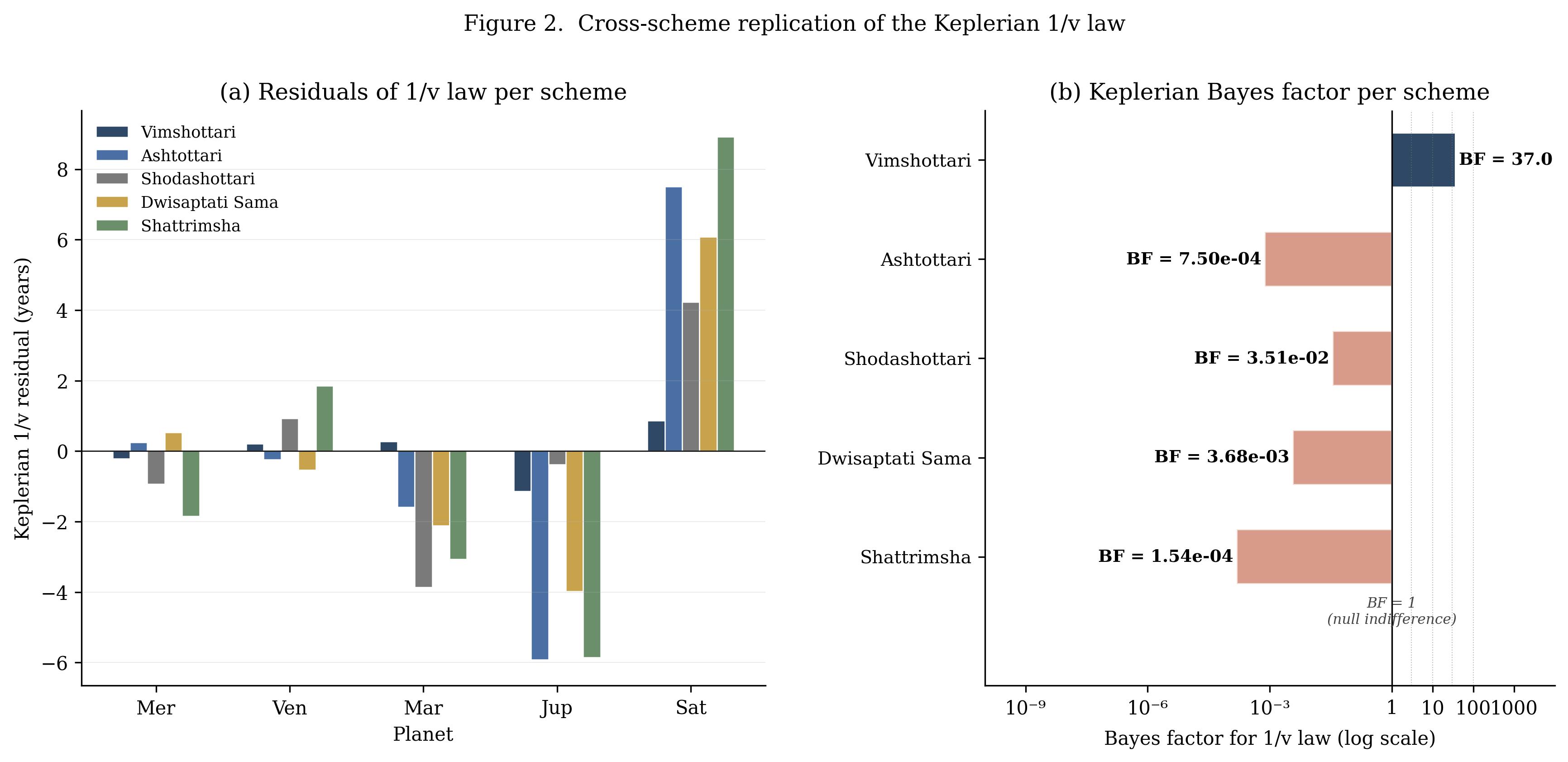
To test whether the Keplerian 1/v signature is a general feature of Indian daśā systems or specific to Vimśottarī, the same analysis has been applied to four additional classical schemes: Aṣṭottarī (108 years, eight grahas), Ṣoḍaśottarī (116 years, eight grahas), Dwisaptati Sama (seventy-two years, seven grahas), and the Ṣaṭtriṃśā or Shatabdika variant (100 years, nine grahas) (Bṛhat Parāśara Horā Śāstra, 1984; de Fouw & Svoboda, 1996; Raman, 2003). For each scheme, the 1/v law is applied within the inner planetary subgroup (Mercury, Venus) and the outer planetary subgroup (Mars, Jupiter, Saturn), using each scheme's own observed partial sums as group totals.
The result is striking: of the five schemes examined, only Vimśottarī exhibits the full Keplerian signature. Table 6 summarises the per-scheme fit statistics and Bayes factors for the 1/v law against a uniform null over integer five-tuples with the same partial sums (see also Figure 2).
Table 6. Cross-scheme replication of the 1/v Keplerian law across five classical Indian daśā systems.
Scheme
Total
In / Out sum
RMSE
Max |err|
R²
Bayes factor
Jeffreys category
Vimśottarī
120
37 / 42
0.67
1.15
+0.991
37.0
very strong
Aṣṭottarī
108
38 / 37
4.33
7.50
+0.277
0.00075
disfavoured
Ṣoḍaśottarī
116
31 / 47
2.63
4.24
−0.637
0.035
disfavoured
Dwisaptati Sama
72
21 / 34
3.40
6.09
−0.446
0.0037
disfavoured
Ṣaṭtriṃśā
100
40 / 40
5.10
8.92
−0.085
0.00015
disfavoured
Note. Bayes factor is for the 1/v law (with marginalised Gaussian noise) against a uniform null over integer five-tuples with the same inner and outer partial sums. Values for the four comparison schemes are drawn from Bṛhat Parāśara Horā Śāstra (1984), de Fouw and Svoboda (1996), and Raman (2003).
Figure 2: Cross-scheme replication of the Keplerian 1/v law across five classical Indian daśā systems. Panel (a): residuals (predicted minus observed) of the 1/v law for each of the five planets in each scheme. Vimśottarī (dark blue) residuals cluster tightly about zero, within ±1.15 years. All four other schemes show systematically large positive Saturn residuals (4 to 9 years) combined with large negative Jupiter residuals, indicating that these schemes assign Saturn fewer years and Jupiter more years than Kepler would predict. Panel (b): Bayes factor for the 1/v law against a uniform null over integer five-tuples with the same partial sums. Only Vimśottarī has a Bayes factor exceeding one (BF ≈ 37, very strong); in every other scheme the 1/v law is actively disfavoured relative to a uniform null.
In Vimśottarī the 1/v law fits with a root-mean-square error of 0.67 years and a Bayes factor of approximately 37, classified as very strong on Jeffreys's scale. In every other scheme examined, the Bayes factor for the 1/v law is less than one — that is, the 1/v law is actively disfavoured relative to a uniform prior over integer tuples with the same partial sums. The residuals are particularly revealing: Aṣṭottarī, Ṣoḍaśottarī, Dwisaptati Sama, and Ṣaṭtriṃśā all exhibit large positive Saturn residuals (4 to 9 years) combined with large negative Jupiter residuals (0 to 6 years), indicating that these schemes systematically give Saturn a smaller daśā and Jupiter a larger one than Kepler's law would predict. This is the exact opposite of the Vimśottarī pattern, in which Saturn receives nineteen years and Jupiter sixteen.
One intriguing partial exception is worth noting. In the inner subgroup alone (Mercury and Venus), both Vimśottarī and Aṣṭottarī show Keplerian ratios within three per cent of the predicted value (Venus / Mercury = 1.176 and 1.235 respectively; Kepler 1.204). The three remaining schemes have inner-group ratios that depart from Kepler by 11 to 17 per cent. This suggests that Aṣṭottarī may share with Vimśottarī a common inner-group allocation principle, but its outer group was constructed on different principles.
The cross-scheme finding sharpens rather than undermines the Vimśottarī result. The Keplerian 1/v law is not a general artefact of Indic daśā construction; it is a feature of Vimśottarī specifically. Whatever produced the numerical pattern observed in Vimśottarī — whether deliberate physical-mechanical design or an extraordinary coincidence — did not extend to the construction of other classical daśā schemes. This makes Vimśottarī a uniquely interesting object within the broader tradition, and identifies a clear target for further historical and textual investigation: what made the Vimśottarī authors choose an allocation that respects Kepler's third law, when their successors working on other schemes did not?
Implications and Next Steps
The cross-scheme comparison is itself the most important next step; this note has now carried it out. Further work in the same direction could examine minor regional or sectarian variants of the five schemes studied here (textual variants exist for each), extend to systems not treated here (Yoginī, where the values are pre-structured as the first eight positive integers and do not permit the same 1/v test; Kālacakra, where the internal structure is organised by rāśi rather than by graha and requires a different analytical framework), and test whether the palindromic priors extend to Aṣṭottarī or other schemes in addition to Vimśottarī. Given that Aṣṭottarī appears to share the Vimśottarī inner-group structure, a palindromic analysis of Aṣṭottarī is a natural follow-up.
Conclusion
A formal Bayesian model comparison provides decisive evidence (Bayes factor approximately 6.7 × 10⁷) that the Vimśottarī Daśā scheme is non-random. Nested decomposition attributes this evidence to three independent bodies of prior knowledge — the sixty–sixty bipartition with Ketu–Mars pairing (Bayes factor approximately 1.1 × 10³), palindromic and Melakarta-motivated priors (Bayes factor approximately 5.9 × 10³ conditionally), and Kepler's 1/v law applied within heliocentric planetary subgroups (Bayes factor approximately 10.3 conditionally) — each statistically significant in its own right. Under this framing, the Vimśottarī scheme contains no irreducibly axiomatic numerical seeds: all nine daśā values are derivable from the combination of structural, palindromic, and Keplerian priors. The Keplerian contribution, at approximately 10.3, is classified as strong evidence on Jeffreys's (1961) scale. Cross-scheme replication against four other classical Indian daśā systems (Aṣṭottarī, Ṣoḍaśottarī, Dwisaptati Sama, Ṣaṭtriṃśā) shows that the Keplerian signature is a feature of Vimśottarī specifically, not of Indic daśā systems in general: in each of the four alternative schemes, the 1/v law is actively disfavoured relative to a uniform null. The combined evidence supports an account of the Vimśottarī scheme as a uniquely structured synthesis of Indic palindromic-numerological knowledge and classical orbital mechanics, within a broader tradition in which most daśā schemes were constructed on other principles.
Data and Code Availability
The planetary velocity values used here are in the public domain, available from the NASA planetary fact sheet and the Jet Propulsion Laboratory Horizons ephemeris system. The analysis code, written in Python, is provided below as a supplementary download.
Burnham, K. P., & Anderson, D. R. (2002). Model selection and multimodel inference: A practical information-theoretic approach (2nd ed.). Springer.
de Fouw, H., & Svoboda, R. (1996). Light on life: An introduction to the astrology of India. Penguin Books India.
Jeffreys, H. (1961). Theory of probability (3rd ed.). Oxford University Press.
NASA Goddard Space Flight Center. (n.d.). Planetary fact sheet. Retrieved April 15, 2026, from https://nssdc.gsfc.nasa.gov/planetary/factsheet/
NASA Jet Propulsion Laboratory. (n.d.). Horizons system. Retrieved April 15, 2026, from https://ssd.jpl.nasa.gov/horizons/
Oshop, R. The hidden architecture of the Vimśottarī Daśā years. Retrieved April 22, 2026, from https://ayurastro.com/writings/the-hidden-architecture-of-the-vimshottari-dasha-years.html
Pingree, D. (1981). Jyotiḥśāstra: Astral and mathematical literature (A History of Indian Literature, Vol. 6, Fasc. 4). Harrassowitz.
Plofker, K. (2007). Mathematics in India. In V. J. Katz (Ed.), The mathematics of Egypt, Mesopotamia, China, India, and Islam: A sourcebook (pp. 385–514). Princeton University Press.
Plofker, K. (2009). Mathematics in India. Princeton University Press.
Raman, B. V. (2003). Hindu predictive astrology. Motilal Banarsidass. (Original work published 1938)
Sambamoorthy, P. (1964). South Indian music (Vols. 1–6). Indian Music Publishing House.
Supplementary Code
The full analysis is released as a Python replication package. vimshottari_calculations.py reproduces every Bayes factor, permutation test, and cross-scheme statistic in this appendix; vimshottari_visualizations.py regenerates Figures 1 and 2 above.