Fire element has lately been on my mind. Mars has been strong in Scorpio, its own sign, the last couple of months, and even now, in Sagittarius, it continues to be strong.
My own inward pitta has been quite high, befitting the transits, a surge in thinking about fire has flowed forth, and my appreciation of the special place of fire has increased. I hope to show you why.
The five elements in the theory of yoga, Ayurveda, and Jyotish are space, air, fire, water, and earth. I have written before of how the knowing of them is at least equal in beauty, power, and insight as knowing the periodic table — see: The Periodic Table and the 5 Elements of Ayurveda.
There are three pitta planets in Jyotish:
- Sun — akin to starting a fire with a lens
- Mars — akin to starting a fire through friction (rubbing sticks)
- Ketu — akin to the resultant smoke
The chemistry of combustion is relevant here. According to that material, combustion can happen in only two ways:
1. Without Carbon (e.g., rocket fuel)
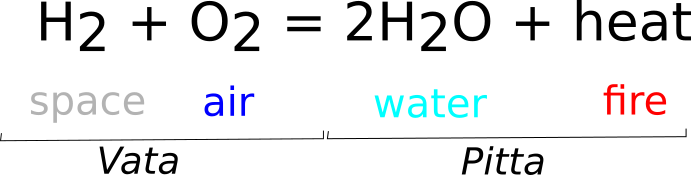
Here, vata is completely transformed to pitta (the combination of water and fire). Since space element is on both sides of the equation, in effect, air is transformed to pitta.
2. With Carbon (e.g., charcoal)
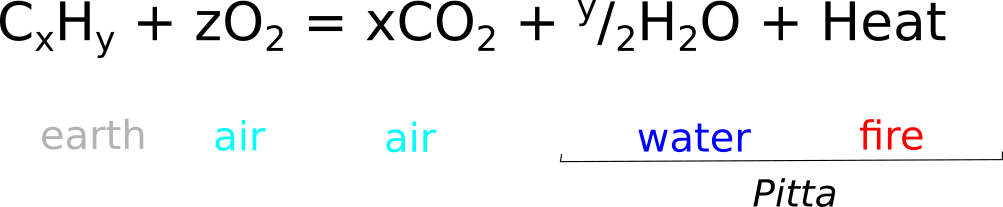
Where z = x + y/4. Here earth and air are completely transformed to air and pitta. Since air is on both sides of the equation, in effect, earth is transmuted to pitta.
Thus, only pitta represents transformation itself.
Kapha cannot be transformed into Vata, nor vice versa. Earth and air can become pitta through methods 1 and 2 above, but not vice versa. Pitta truly is at the apex of the equilateral triangle representing the three doshas of vata, pitta, and kapha.

It is appropriate that the tantric symbol for fire is the triangle, which even looks like a flame. We see this everywhere. To be sure, fire is needed for any transformation, and transformation is heat (destructive potential) and light (constructive potential).
- The heat is tamas, Mars. That is why Mars is a tamasic graha.
- The light is Sun. Sattva. That is why the Sun is a sattvic graha.
- The flame itself is rajasic — highly movement-oriented, movement for movement's sake — and may be represented by Ketu.
Thus, pitta represents all three of the mahagunas: sattva, rajas, and tamas.
Finally, to increase your own pitta — including sadhaka pitta, the brilliance of the brain — know that fire requires the twin fuels of carbon and oxygen, of earth and air. (Space as well, but space is assumed and everywhere in the equations, unchanging, unmoving, perfect.)
Increase your pitta by eating well (the fuel of carbon) and breathing well (the fuel of oxygen). Everything else will surely take care of itself — the flames moving to a dance of their own accord, transforming you in a way you can trust, in a way that is uniquely complete.
Thus, only pitta involves the totality of life, the totality of the material universe, of all five elements, as well as all three of the mahagunas.
Fire is life.
Perhaps this is why the all-important first word of the Rig Veda is agni — flame — and perhaps this is why Dr. Lad says that agni, our own inner flame, is our life, its measure, its potential, and its meaning.
This is why one must attend to one's own inner pilot light, one's cellular agni, so that the flames of perception, transformation, and power are lit appropriately. Do you feel your agni may be low? No need for worry — there are herbs for that.